Brand strategy is the long-term plan that defines what your business stands for, who it’s for, and how it’s perceived across every touchpoint. It matters for growth because it decides whether people choose you before price or product enters the conversation. Consistent brand presentation is linked to roughly a 23% revenue lift.
Key takeaways
|
What is brand strategy, exactly?
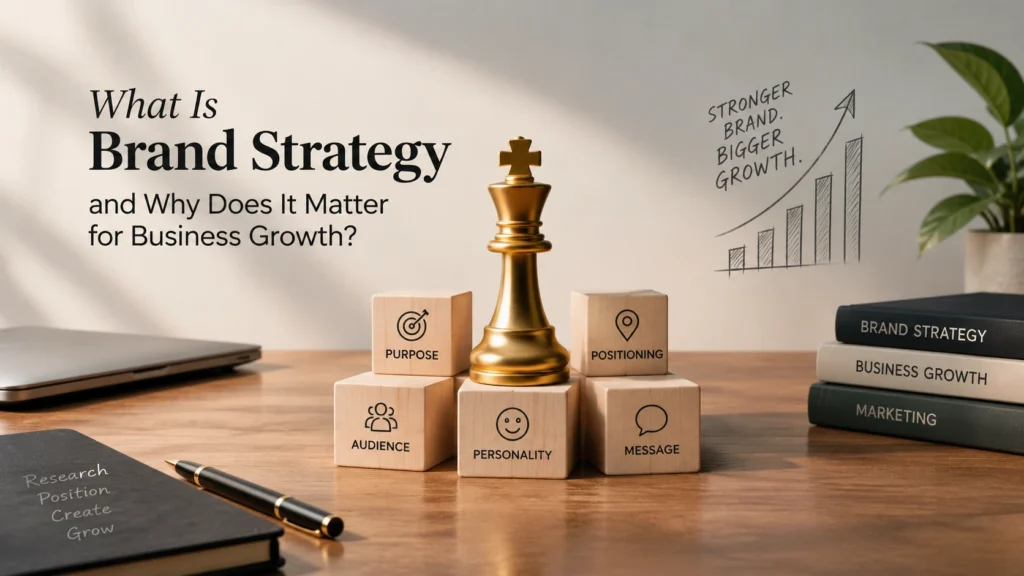
Brand strategy is a business’s long-term plan for how it wants to be understood in the market. It defines purpose, positioning, target audience, personality, and core message, then guides every decision that follows. Think of it as the source code. The logo, website, and ads are the interface.
Here’s the distinction that trips most owners up. Branding is what you make. Brand strategy is why you made it that way. A rebrand that changes colors without changing the underlying positioning is decoration, not strategy. And decoration doesn’t move revenue.
How is brand strategy different from marketing?
Brand strategy is relatively fixed and sets long-term direction. Marketing is fluid and runs shorter campaigns to hit near-term goals. One is the destination and the rules of the road; the other is the vehicle you drive this quarter. Marketing without a brand strategy underneath it tends to drift.
Dimension | Brand strategy | Marketing strategy |
Time horizon | Multi-year, revisited every 2-3 years | Quarterly to annual, constantly adjusted |
Job | Defines meaning, positioning, value | Drives awareness, leads, and sales |
Output | Positioning, messaging, identity system | Campaigns, ads, content, promotions |
Changes | Rarely, deliberately | Often, in response to data |
Both should stay adaptable. But if the marketing keeps changing because nobody agreed on what the brand actually is, that’s a positioning problem wearing a marketing costume.
Why does brand strategy matter for business growth?
Brand strategy matters because it improves the efficiency of everything else you spend on. When people already understand who you are and why you’re different, your ads convert better, your content lands faster, and your sales calls get shorter. It turns scattered activity into compounding advantage.
There’s a moment most growing companies hit. Traffic is fine, campaigns are running, and results get more expensive to maintain anyway. That’s usually not a channel problem. It’s a clarity problem. When the brand is defined, the audience shows up already knowing what you stand for, and acquisition costs stop climbing for no visible reason.
The commercial case isn’t soft either. Research from Lucidpress (now Marq) found that companies presenting their brand consistently across channels see an average revenue increase of about 23%, per Demand Metric and Lucidpress survey data. Later research raised that ceiling to 33%. Treat the exact figure as directional, since it comes from marketer surveys rather than audited books. The direction is consistent across every study: clarity and consistency track with revenue.
It builds trust before the first sales conversation
Trust is now a purchase gate, not a nice-to-have. Edelman’s Trust Barometer found that 81% of consumers say brand trust is a deciding factor when they consider a purchase, trailing only quality and value. By Edelman’s 2026 reading, 88% now rank trust on par with quality and price. A brand strategy is how you earn that trust deliberately instead of hoping for it.
It lets you charge more
Undifferentiated businesses compete on price, and price is a race nobody wins. A clear strategy gives buyers a reason to pick you that isn’t the cheapest number, which is what makes premium pricing hold. We’ve watched this play out on client accounts: the moment positioning gets sharp, the discount requests slow down.
What are the core elements of a brand strategy?
A working brand strategy answers a short set of questions clearly. Not every element needs a chapter. It needs to be decided, written down, and used to settle arguments. These are the pieces that actually change behavior.
- Purpose and values – why the business exists beyond making money, and what it won’t do.
- Positioning – the specific space you own in the buyer’s mind versus named competitors.
- Target audience – who you’re for, and just as importantly, who you’re not for.
- Messaging – the core promise and the proof points that back it up.
- Brand voice – how you sound, so the brand is recognizable with the logo removed.
- Visual identity direction – the look that expresses all of the above consistently.
Positioning is the one that carries the most weight. Get it wrong and every downstream asset inherits the confusion. Get it right and the rest of the work almost briefs itself.
Not sure whether your growth problem is a channel problem or a positioning problem? A benchmarked growth audit will tell you which, using your own numbers. |
How do you build a brand strategy that supports growth?
You build it by deciding, in order: who the buyer is, what they currently believe, what you want them to believe instead, and the single idea that closes that gap. Everything else is execution. The sequence matters more than the format you capture it in.
A practical build looks like this. Start with research real conversations with customers and a hard look at competitors, not assumptions in a conference room. Define positioning as a sentence you’d defend under pressure. Write the messaging and voice so anyone on the team can produce on-brand work without checking with you. Then hand it to design and performance media as a brief, so the look and the ads both express one idea rather than three.
And keep it short. The strategy that gets used is the one people can hold in their head. A tidy document that lives in a folder changes nothing.
How long before brand strategy affects revenue?
Some effects are immediate and some compound. Sharper positioning improves conversion and sales conversations within weeks, because the message finally matches what the buyer needs to hear. The larger gains trust, loyalty, pricing power build over quarters as consistency accumulates across every touchpoint.
This is where discipline separates results from intentions. Roughly 95% of companies have brand guidelines, but only about 25% enforce them consistently, according to widely cited Lucidpress data. The gap between owning a strategy and running it is where most of the revenue quietly leaks out.
Where does brand strategy fit with performance media and AI?
Brand strategy decides what to say and to whom. Performance media decides how to put it in front of the right people and turn attention into revenue. They’re not competitors for budget. A brand strategy without distribution stays theoretical, and paid media without a strategy underneath it just buys clicks that don’t convert.
At Morphiaas USA, a performance marketing agency serving businesses across the United States, we treat the two as one system. Strategy sets the message, then our performance media program puts it against real budget and reports back to revenue. For companies scaling creative output, our growth, technology and AI work keeps that message consistent across a hundred ad variations without diluting it.
Frequently asked questions
Is brand strategy only for big companies?
No. Small and mid-sized businesses arguably need it more, because they can’t outspend larger competitors and have to out-position them instead. A clear strategy is what lets a smaller brand win a specific audience decisively rather than being a weaker option for everyone.
What’s the difference between brand strategy and a brand guideline?
The strategy is the thinking: positioning, audience, message, and the reasoning behind them. The guideline is the rulebook that keeps execution consistent: logo usage, colors, typography, tone. You decide the strategy first, then document the guidelines so the strategy survives contact with a growing team.
How often should we revisit our brand strategy?
Most brands review strategy every two to three years, or sooner after a major shift — a new market, a pivot, a merger, or a competitor that reframes the category. It’s meant to be relatively fixed. Changing it every quarter defeats the point.
Can brand strategy actually be measured?
Yes, through proxies. Track brand search volume, direct traffic, conversion rate on branded versus non-branded audiences, win rate on sales calls, and willingness to pay a premium. You won’t get one clean number, but the trend across those signals tells you whether the strategy is working.
Do we need a brand strategy before running ads?
You can run ads without one, and plenty of businesses do. They just pay more for worse results. Ads built on a clear position convert at higher rates because the message already resonates, so the strategy usually pays for itself in reduced acquisition cost.
If your positioning is fuzzy and your acquisition costs keep climbing, that’s a fixable problem. Get a benchmarked growth audit and a plan you keep whether or not we work together. |
Morphiaas USA · 1-281-413-0382 · hello@morphiaasusa.com · 1502 Utah St, Houston, TX