
Car dealership brand positioning is the specific reason local buyers pick your store over the one down the road. It matters more than ever because new-car front-end gross fell to $1,840 per vehicle in Q2 2026, down 13.5% in a year. When five dealers sell the same truck at nearly the same price, the car stops being your edge.
Key takeaways
- Positioning is the space your store owns in a buyer’s mind, not your logo or your ad budget.
- New-vehicle gross profit dropped to $1,840 per unit in Q2 2026, so price is a losing game.
- Franchise dealers sell identical inventory, which means the product can’t be your difference.
- Build positioning in five steps: pick your buyer, study rivals, name one real difference, write it down, apply it everywhere.
- A distinct store holds gross and earns referrals. A generic one rents customers on price.
What car dealership brand positioning actually means
Car dealership brand positioning is the specific space your store owns in a local buyer’s mind compared to rival dealers. It answers one question for the shopper. Why buy here instead of the other lot across town? It’s a decision about what you stand for, made before any ad runs.
People mix this up with branding and advertising, so let’s split them. Your logo, your signage, your color scheme are branding. Your Google ads and TV spots are advertising. Positioning sits underneath both and tells them what to say. Get it wrong and every dollar you spend points in a different direction.
Here’s the part most dealers skip. If you run a Toyota store, so do a dozen others in your region, selling the same Camry off the same truck. The vehicle cannot be your differentiator when everyone stocks it. Your positioning has to come from something the car doesn’t give you. Maybe you’re the truck store built for contractors. Maybe you’re the first-time-buyer specialist who actually gets people approved. “Great customer service” is not positioning. Every dealer on the strip claims it, so it means nothing.
Why positioning decides dealership profit now, not just image
Positioning used to sound like a branding luxury. Now it’s a margin strategy, because the money on new cars has thinned to almost nothing. Front-end gross on new units has compressed to somewhere between $500 and $1,500 at many stores, and Presidio-NCM benchmark data reported by Digital Dealer puts average new-vehicle gross at $1,840 per unit. The days of $3,000 gross on a mainstream new car are largely gone.
Think about what that leaves you. On new vehicles, the net margin at a lot of dealerships now runs close to zero, which means the sale itself barely pays. Online pricing tools and Carvana-style retailers stripped away the information gap buyers used to have. Your shoppers walk in already knowing the invoice, the incentives, and what three other stores quoted.
So if you compete only on the lowest number, you’re renting customers. They came for a price and they’ll leave for a cheaper one next time. A dealer with a clear position gives people a reason to choose the store that isn’t the sticker, and that reason is what protects your gross. It’s also what turns one sale into a referral instead of a one-night stand.
Not sure what your store should stand for, or where you’re leaking gross to the price war? A benchmarked growth audit maps your position against local rivals, using your own numbers. |
How to build your dealership's brand positioning in 5 steps
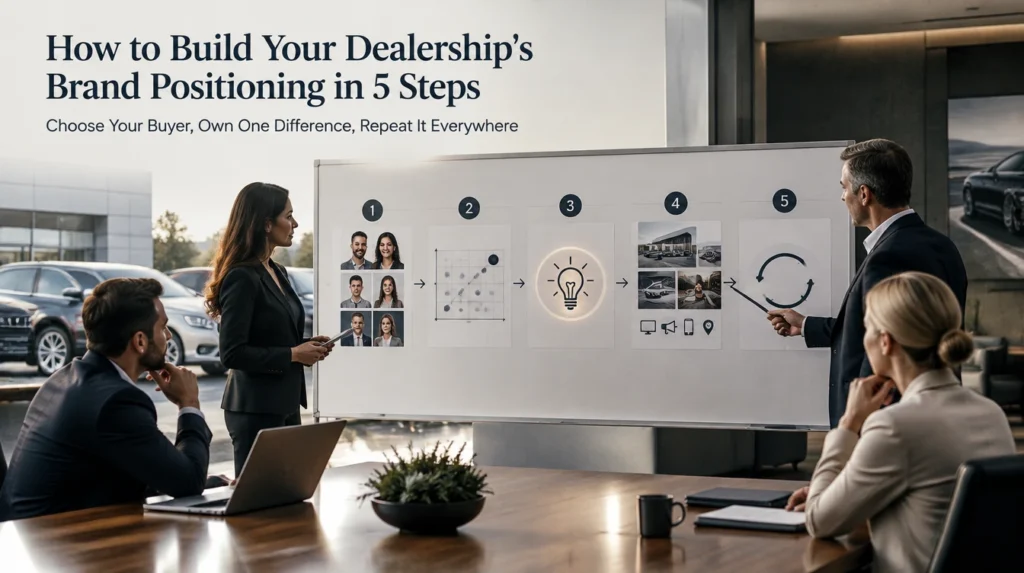
You build a position by deciding who you win, what nobody else owns, and how you prove it. The steps run in order, because each one feeds the next. Skip straight to the slogan and you’ll end up with words that sound nice and change nothing.
Find the buyer you actually win
Start with the customer your store already serves better than anyone. Look at your best deals and your happiest reviews, then find the pattern. Maybe it’s contractors who need work trucks fast. Maybe it’s budget buyers other stores turn away. Pick that group on purpose. When you try to be for everyone, you become the obvious choice for no one.
Study the other dealers in your market
You can’t claim a space a rival already owns in the buyer’s head. List the dealers in your area and write down what each one leads with, price, selection, luxury, speed. Look for the gap. If every store in town shouts about low prices, the dealer who owns “no pressure, no games” stands out by contrast alone.
Name one specific difference you can defend
Pick a single difference that’s true, provable, and worth something to your buyer. One is enough. And it has to be concrete. “Same-day delivery on any in-stock truck” is a position. “We treat you like family” is a greeting card. If you can’t back it up on the lot every day, it isn’t your difference yet.
Write it as a positioning statement
Put the whole thing into one sentence your team can repeat. Use this shape: for [local buyer] who [need], [your dealership] is the [store type] that [specific difference]. Keep it internal. It’s the compass every ad, script, and sign checks against, not a tagline you slap on a billboard.
Put it everywhere the buyer meets you
A position only works when the buyer hits it at every turn. Your lot signage, your sales scripts, your Google Business Profile, your ads, your service drive, all of them say the same thing. Start with your team, because a salesperson who can’t explain what makes the store different won’t sell it. Consistency is the mechanism that turns a sentence into a reputation.
What separates a dealership that stands out from one that blends in
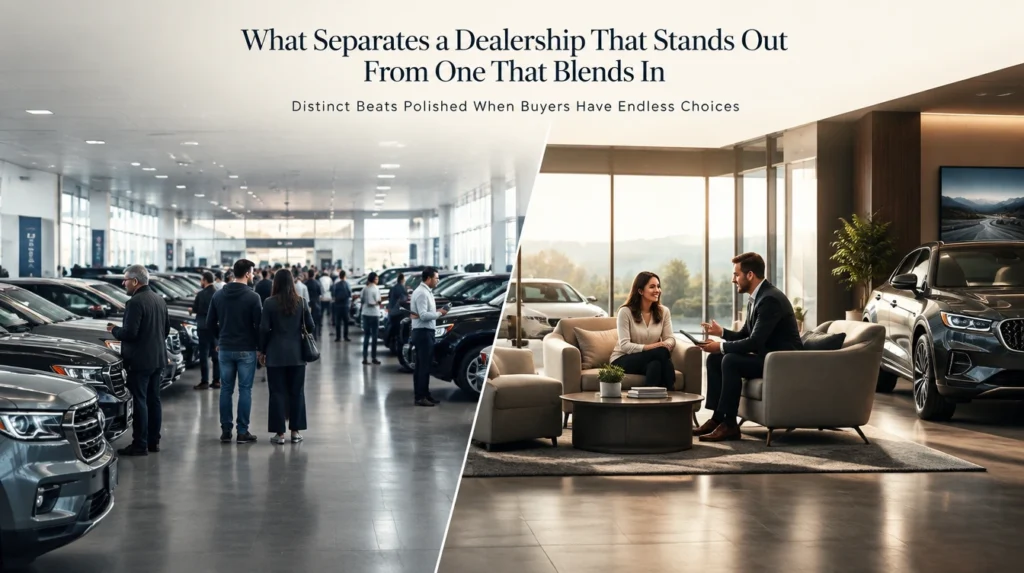
A stand-out dealership owns one clear idea and repeats it everywhere. A blend-in dealership sounds like every other lot and competes on price by default. The difference shows up in the reviews, the referral rate, and the gross you keep. Same market, very different economics.
| Signal | Blends in | Stands out |
|---|---|---|
| Its USP | “Great service, great prices” | One specific, provable claim |
| Sales conversation | Defends the price | Explains the difference |
| Reviews mention | “Got a good deal” | The exact thing it’s known for |
| Referrals | Rare, price-driven | Frequent, reputation-driven |
| Gross retention | Erodes with every quote | Holds because trust is built in |
One line matters more than the rest. Distinct beats polished. A store that sounds professional and generic gets forgotten the moment the buyer opens another tab. A store known for one specific thing gets remembered and gets called back.
How positioning connects to the rest of your dealership marketing
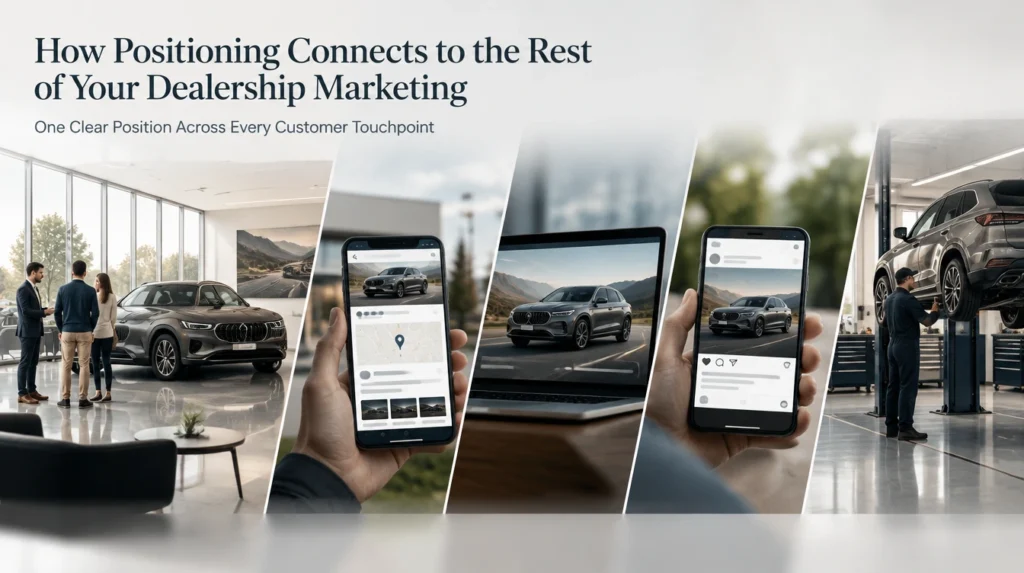
Positioning is the brief that every ad, post, and campaign answers to. It comes first, then the channels carry it. Most dealership marketing guides jump straight to SEO, social, and paid tactics, but those only work when they’re all pushing one clear idea instead of five scattered ones.
At Morphiaas USA, a performance marketing agency serving businesses across the United States, we treat positioning as the decision that makes the ad spend work. Our brand strategy work defines what your store stands for, then our performance media program puts that message in front of local buyers and reports back to revenue. For the wider playbook, our guide on building a brand positioning strategy walks through the full framework beyond automotive.
Frequently asked questions
How is dealership positioning different from branding?
Positioning is the strategic space your store claims in buyers’ minds. Branding is how that space looks and sounds, your logo, colors, and signage. Positioning is the decision; branding is the expression of it. You settle the position first, then build the branding to match, not the other way around.
Can an independent used-car lot out-position a big franchise dealer?
Yes, and often more easily. Big franchise dealers position broadly to appeal to everyone, which leaves clear gaps. A smaller lot that owns one specific space, say certified work trucks or first-time-buyer financing, can dominate that niche while the large dealer stays generic and forgettable to that buyer.
How long before positioning affects sales and gross?
Sharper sales conversations and better close rates can show up within weeks, because your team finally has a clear reason to give buyers. The bigger gains, reputation, referrals, and held gross, build over a few months as the same message repeats across every touchpoint in your market.
Do we need positioning if we already spend heavily on ads?
Especially then. Heavy ad spend without a clear position just buys clicks that don’t convert, because the message keeps shifting. Positioning makes every ad dollar work harder by giving all your campaigns one consistent reason to choose your store, which lowers your cost per sale over time.
What’s a positioning example for a car dealership?
A used-truck lot could own “the contractor’s truck store, every unit work-ready and delivered same day.” That names a specific buyer, a specific need, and a provable difference. Compare that to “quality vehicles at great prices,” which every dealer says and no buyer remembers. Specific always wins.
The car isn’t your differentiator anymore, and the price war has a floor you can’t win under. Get a benchmarked growth audit and a positioning plan you keep whether or not we work together.
Get a benchmarked growth audit
What do you think?
[…] buyers and reports back to revenue. For the differentiation side of the equation, our guide on car dealership brand positioning covers how to stand out once buyers trust […]
Comments are closed.