
A practical guide for brands, marketers and founders who want consistent creative work
Creative direction vs art direction comes down to two questions. Creative direction decides what a brand says and how it feels across every channel. Art direction decides how that idea looks, from color and type to imagery and layout. One role owns the idea, the other owns the look, and consistent brands assign both.
A marketing manager opens three campaign mockups from three different designers, and none of them look like the same brand. The colors clash, the tone shifts from playful to formal, and nobody can say which version is right. That confusion usually comes from skipping two separate questions, which is the core of creative direction vs art direction.
The first question asks what the brand should say and feel. The second asks how that idea should look. Two different roles usually answer them, and teams that assign each one clearly produce more consistent work.
This guide defines both roles in plain language. It compares them side by side, walks through a worked example, explains how to write a creative brief and lists the mistakes that lead to inconsistent branding.
Key takeaways
•Creative direction sets the idea, message and tone. Art direction sets the look.
•In most agencies the art director reports to the creative director.
•Fix the message first. Better visuals can’t rescue an unclear idea.
•One person can do both jobs if they settle the idea before the styling.
•A one-page brief and one named approver prevent most inconsistent work.
What is creative direction?
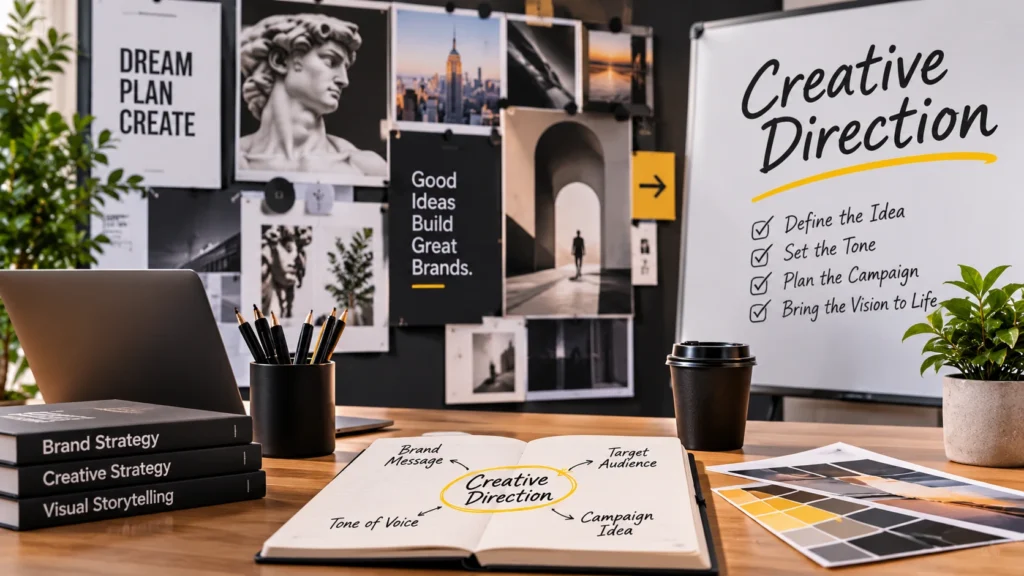
Creative direction is the work of deciding what a brand or campaign should say and how it should feel. A creative director sets the central idea, the tone of voice and the quality standard that every piece of work must meet. The role usually covers copy, design, photography, video and social content together.
Creative directors guide the people who produce the work. They review ideas, give feedback and decide which concepts move forward. On large projects they lead a team of designers, writers and art directors. On smaller projects they may also make some of the work themselves.
For a deeper explanation of the role, Morphiaas USA has a full guide to what creative direction is. Morphiaas USA is a performance marketing agency serving businesses across the United States.
Example: A creative director for a tea brand might decide that every campaign should feel calm, unhurried and rooted in daily rituals. That decision shapes the packaging, the product photos, the email copy and even the tone of customer replies.
For a closer look at the strategic role behind campaign ideas, read What Is Creative Direction? Definition, Process, Examples.
What is art direction?
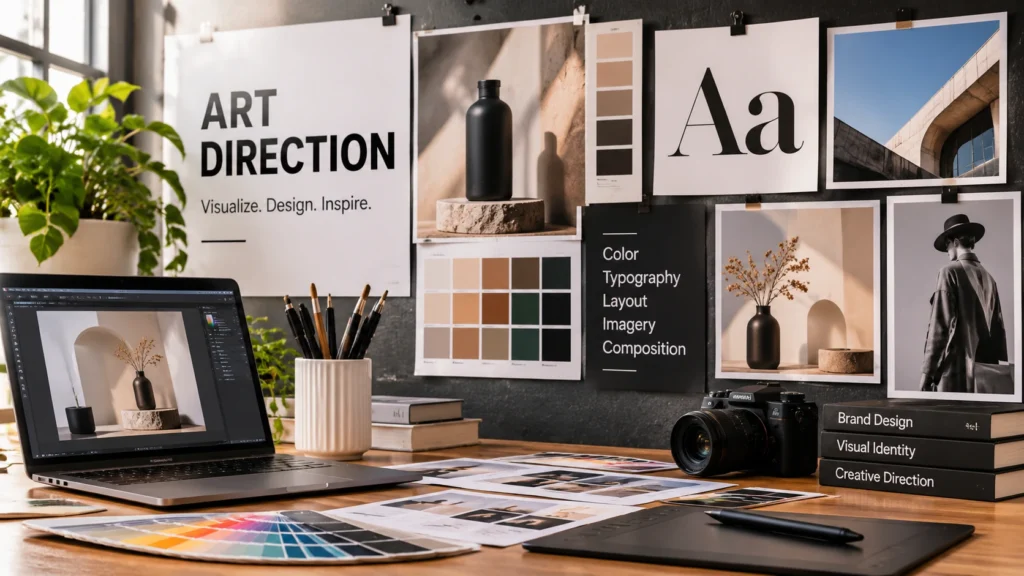
Art direction is the work of turning an idea into a consistent visual style. An art director chooses the color palette, typography, layout, imagery and overall look of a piece. They decide how a photo is lit, how a page is composed and how a campaign appears on screen or in print.
Art directors usually work closely with designers, photographers, illustrators and copywriters. They brief the team, review layouts and check that each asset follows the same visual rules. Their focus is the look of the work rather than the direction of the whole brand. The U.S. Bureau of Labor Statistics counts about 140,200 art director jobs in the United States as of 2025. It describes the role as deciding how best to represent a concept visually.
Example: For the same tea brand, the art director might choose warm earthy tones, soft natural light and a clean serif typeface. They would brief the photographer on props and framing, then check that every product image matches.
To connect the visual system to long-term positioning, explore Morphiaas USA’s brand strategy services.
How does creative direction vs art direction compare side by side?
Creative direction vs art direction differs mainly in scope. Creative direction owns the idea, message and tone for a whole brand or an entire campaign. Art direction owns the visual style that carries that idea, including color, type, imagery and page layout.
The table below summarizes how the two roles usually differ. Job titles and responsibilities vary between companies, so confirm what each role covers on your own team.
Creative direction | Art direction | |
Main question | What should the brand say and feel? | How should that idea look? |
Scope | The whole brand or campaign across channels | The visual side of a project or campaign |
Typical decisions | Concept, message, tone of voice and quality standards | Color, typography, layout, imagery and styling |
Typical deliverables | A guiding idea, a creative brief and final approvals | A visual style, mood boards and art-directed assets |
Works with | Art directors, copywriters, strategists and producers | Designers, photographers, illustrators and editors |
Success looks like | Every channel tells the same story | Every asset looks like it belongs to one brand |
How do the two roles split work on each channel?
In practice, creative direction vs art direction splits the work the same way on every channel. The creative director decides the message, and the art director decides how it looks. Each channel needs both an idea and a visual style to feel like one brand.
Customers notice when teams don’t line up. Salesforce research found that 69% of consumers expect consistent interactions across departments. A shared direction helps every team deliver that.
•Website. The creative director decides the story the homepage tells. The art director chooses the layout style, imagery and typography that carry it.
•Social media. The creative director sets the themes and tone for posts. The art director defines the templates, color use and photo style that make the feed recognizable.
•Packaging. The creative director decides what the pack should communicate at a glance. The art director selects the type, illustration, finishes and color treatment.
•Video. The creative director shapes the concept and the direction of the script. The art director guides the set design, color grading and framing.
Where do creative direction and art direction overlap?
Creative direction and art direction overlap wherever consistency is at stake. Both roles review creative work, protect the brand’s standards and need strong visual judgment. In many agencies, the art director reports to the creative director, who sets the overall direction.
Small businesses often blur the line completely. A single person may set the concept, choose the visuals and brief the freelancers. That works well when the person is clear about which hat they’re wearing at each stage.
What does the handoff look like from brief to launch?
The handoff runs in one direction and then loops back for review. The creative director writes the brief, the art director turns it into a visual style, and the team produces the assets. Both leaders then review the work against the original idea.
Imagine a footwear brand preparing a summer launch. The steps below show how the two roles hand work to each other.
1.The creative director writes a short brief that names the audience, the goal and the core message of slow evening walks after work.
2.The art director turns that message into a visual style with golden-hour photography, muted colors and relaxed typography.
3.Designers, photographers and writers produce the ads, product pages, social posts and emails.
4.The art director reviews each asset for visual detail, such as crops, color accuracy and type spacing.
5.The creative director confirms that the finished campaign still serves the original idea and approves it for launch.
How do you write a creative brief?
Write a creative brief as a one-page document that names the audience, goal, core message, tone, visual references, deliverables, constraints and approver. It aligns everyone before work begins. A clear brief saves time because designers and writers no longer have to guess what you want.
A useful brief covers the points below. Morphiaas USA’s guide to what brand strategy is explains how to define the positioning behind it. In the creative direction vs art direction split, the creative director usually owns the brief, and the art director adds the visual references.
•Audience. Describe who you’re speaking to and what they care about.
•Goal. State what the work should achieve, such as launching a product or building awareness.
•Core message. Write the one idea a customer should remember.
•Tone of voice. Name three or four words that describe how the brand sounds.
•Visual references. Add examples of colors, photography styles and layouts that fit.
•Deliverables. List every asset needed, with formats and sizes.
•Constraints. Include budget, deadline and any legal or brand rules.
•Approver. Name the person who gives final sign-off.
Example brief: A footwear brand wants to launch a summer collection for busy professionals who walk to work. The goal is to drive visits to the new collection page. The message is that the walk home is the best part of the day, and the tone is warm, relaxed and confident. Visual references include golden-hour street photography and soft earth tones.
Before developing the visual direction, use this guide to building a creative strategy to align business goals, audience insight, messaging, and creative execution
Which role does your brand need first?
Start with creative direction when the brand’s message is unclear. If customers can’t describe what you stand for, better visuals won’t solve the problem on their own. Start with art direction when the message is clear but the visuals look inconsistent. A brand with a strong idea and a messy feed needs a visual system more than a new concept. If the message itself is unclear, start by defining your brand strategy.
That choice matters because consistency has a measurable payoff. A 2019 Lucidpress survey of more than 200 organizations found that consistent branding can increase revenue by up to 33%. Treat that as directional, since it comes from a vendor survey.
•Choose creative direction when you’re launching a new brand, repositioning an existing one or planning a major campaign.
•Choose art direction when you already have a message and need a consistent look across product pages, social posts and ads.
•Use both when a campaign spans several channels and several creators
How can a small team cover both roles?
A small team can cover both roles by splitting the work into stages instead of hiring two people. Settle the idea first, then define the look, then review in two passes. One person can wear both hats if they know which stage they’re in.
Most small teams can’t afford separate people for each role. The stages below give you the same benefits without extra headcount.
1.Settle the idea first. Write the brief and agree on the message before anyone opens a design tool.
2.Define the look second. Create a short style guide with colors, fonts, image treatment and layout rules.
3.Review in two passes. Check the message first, then check the visual details.
This habit keeps feedback focused. Designers receive clear instructions, and the founder avoids rewriting the concept halfway through production. Many small teams hire freelancers, and the BLS reports that 62% of art directors are self-employed. Teams that want hands-on help with the visual side can explore Morphiaas USA’s creative and design services. You can also book a growth audit to see where the brand drifts across channels.
What should you ask before you hire a creative or art director?
Ask who decides the concept, who approves the final visuals and how the candidate keeps work consistent across channels. Those three answers show whether someone can lead the idea, the visuals or both. When you’re weighing creative direction vs art direction, they also reveal which role your project needs first.
•Ask who decides the concept and who approves the final visuals.
•Ask to see how the candidate kept work consistent across more than one channel.
•Ask how they give feedback to designers and photographers.
•Ask how they would document the visual rules so your team can follow them.
•Look for a portfolio that shows clear reasoning behind each project, not only polished images.
•Budget realistically, since the BLS reports a median annual wage of $114,850 for art directors as of May 2025. That figure excludes self-employed workers, so freelance rates vary.
What mistakes cause inconsistent branding?
Inconsistent branding usually comes from unclear ownership, a missing brief and visuals chosen before the idea. Creative direction vs art direction confusion makes each of those problems worse. Lucidpress reported in 2019 that 81% of companies still deal with off-brand content.
•Using the titles interchangeably. Agree on what each role owns before the project starts.
•Skipping the brief. Write a one-page brief that covers audience, tone, message and visual references.
•Choosing visuals before the idea. Pick the concept first, then let the style follow it.
•Letting each channel drift. Review social, web and email work together at least once per campaign.
•Leaving approval unclear. Name one person who gives final sign-off so revisions don’t stall.
•Giving vague feedback. Say what should change and why, instead of saying you don’t like it.
•Skipping documentation. Save your colors, fonts and image rules in a shared style guide.
•Treating visuals as decoration. Ask what each image says about the brand before you approve it.
Most inconsistent brands don’t have a design problem. They have a decision problem, and no amount of polish fixes that.
Frequently asked questions
What is the difference between creative direction and art direction?
Creative direction decides the overall idea, message and tone of a brand or campaign. Art direction decides how that idea looks, including color, type, imagery and layout. The first sets the vision, and the second shapes the visual style.
Is a creative director above an art director?
In many agencies, yes. The art director usually reports to the creative director, who oversees the whole project. Structures differ between companies, so titles don’t always show who leads.
Can one person do both jobs?
Yes, especially in small teams and young brands. One person can set the concept and also direct the visuals. It helps to separate the two stages so that the idea is settled before the styling begins.
Do small businesses need a creative director?
Small businesses need creative direction, though not always a full-time hire. A founder, a freelancer or an agency can provide it. What matters is that someone owns the idea and keeps the work consistent.
What skills does an art director need?
An art director needs a strong eye for typography, color, composition and imagery. They also need to brief creatives clearly and give useful feedback. Knowing how a design behaves across print and screen is a real advantage.
How do I know if my brand work is consistent?
Place your website, social posts, packaging and ads side by side. If they look and sound like the same brand, the work is consistent. If not, note where the style, tone or message changes and fix those gaps first.
Final thoughts
Creative direction vs art direction isn’t a title debate. It’s a decision about who owns the idea and who owns the look. Creative direction sets the idea, and art direction shapes how that idea looks. When both are clear, teams brief faster, review more easily and produce work that feels like one brand. Write down who owns each decision on your next project, and your first review will go more smoothly. If you want an outside view of your brand, get a benchmarked growth audit from Morphiaas USA.