
Marketing automation for lead generation and nurturing is what separates US B2B teams converting 13% of their MQLs to opportunities from the ones converting 22%. That’s Salesforce Pardot’s 2024 benchmark against mature-program performance. The gap closes with sequence design, scoring logic, and routing discipline, not with buying a bigger tool.
Key Takeaways
- Nurtured leads produce 20% more sales opportunities than leads left alone (DemandGen, 2023).
- Mature B2B programs convert MQLs to opportunities at 18 to 22%, versus the 13% median (Salesforce, 2024).
- B2B automation emails average 30.8% open rate; lower reads as a reach or relevance problem (HubSpot, 2024).
- Cost per qualified lead drops roughly 38% within 18 months of implementation (HubSpot, 2024).
- Most teams don’t need more automation. They need fewer touches aimed at better-qualified contacts.
What is marketing automation for lead generation and nurturing

The system itself is a connected software stack. It captures prospects, segments them, scores behavior, and runs multi-touch outreach without manual sending. It covers the moment a visitor fills a form through the handoff to a sales rep. One job runs behind all of it: never let a warm prospect cool.
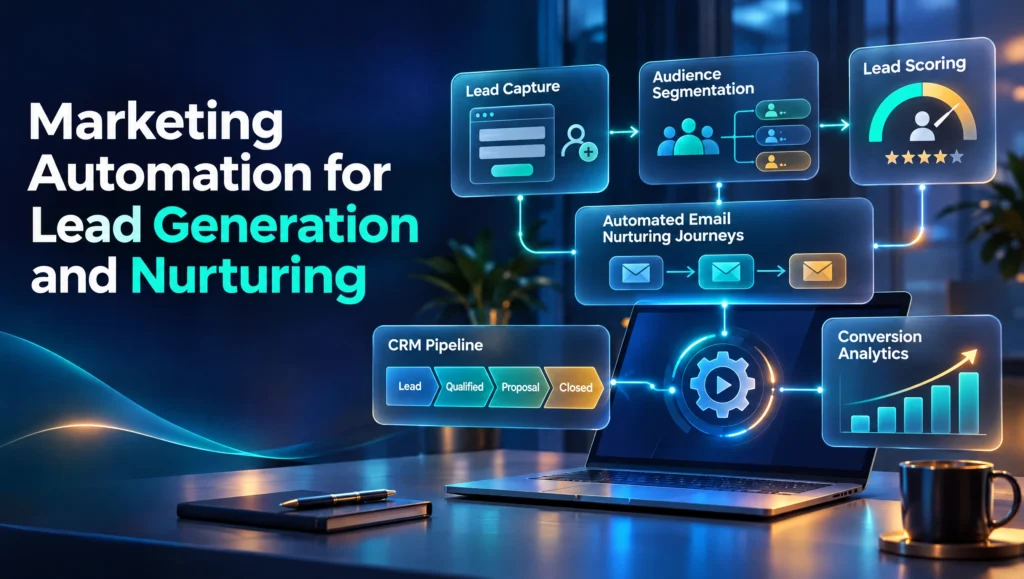
Five pieces of the stack do the real work. Form capture pulls contacts off a landing page into the database. Segmentation sorts them by fit (industry, role, company size) and behavior. Lead scoring weights each signal, so a pricing-page visit matters more than a blog subscribe. Sequencing fires the right message at the right moment. CRM sync keeps sales looking at one record, not three.
An MQL (marketing-qualified lead) is a contact marketing judged ready for a sales touch. An SQL (sales-qualified lead) is one sales has accepted. The handoff between them is where most leaks happen.
Morphiaas USA, a performance marketing agency serving businesses across the United States, runs these stacks for US B2B clients. The category is projected to hit $15.58 billion by 2030, per Grand View Research.
How does marketing automation actually generate leads

Marketing automation doesn’t create demand on its own. It captures and qualifies the demand you create elsewhere. That demand comes from paid media, organic search, content, events, and referrals. Automation routes it, scores it, and makes sure nothing sits in an inbox nobody checks.
Three concrete lead sources run through automation by default. The first is paid-to-form: an ad drives traffic to a landing page, the form fires into the CRM, a welcome sequence starts inside two minutes. The second is gated content: a prospect trades an email for a report or template. Progressive profiling then fills in role, company size, and intent over the next three or four downloads. The third is website behavior: a visitor hitting the pricing page twice in 48 hours drops into a sales-alert queue, not a drip.
The third source is the one most teams underbuild. Drip campaigns treat every contact the same. Behavior triggers treat buying signals as buying signals. And buying signals convert faster than content signals do.
Marketing automation that generates leads without a paid or organic engine behind it is a drip campaign to nobody. Build the top of the funnel first. Our performance media work is where that engine gets built.
What does a B2B lead nurturing workflow look like

A B2B lead nurturing workflow is a timed, trigger-based sequence of touches that moves a contact from first interest to sales-ready. It runs mostly over email, with LinkedIn and SMS added where warranted. Each message earns the next by changing what the prospect knows or believes about the decision in front of them.
Here’s a 5-touch sequence that works for mid-funnel US B2B prospects:
- Day 0: welcome and relevance. One sentence confirms what the prospect asked for, one explains who it’s for, one links the next useful read.
- Day 2: proof asset. A case study, benchmark report, or short video showing a result in the prospect’s industry.
- Day 5: objection-handling piece. This addresses the single biggest reason this buyer type says no.
- Day 9: social proof. A customer quote, review excerpt, or named logo, kept short and credibility-forward.
- Day 14: soft CTA to a call or demo. One button, one question above it: “Still weighing this? Fifteen minutes on your calendar.”
Each touch triggers the next only if the prior one got opened or clicked. A cold-after-day-5 contact drops into a slower quarterly nurture, not a tighter drip. A B2B automation email clearing a 30.8% open rate is sitting at the HubSpot State of Marketing 2024 benchmark. Clearing 40% means your list and subject lines are doing real work. And the three-second subject-line test practitioners run: read it aloud, and decide if a busy VP would pause. If the answer is no, the subject line needs a rewrite.
How do you track whether marketing automation is working

Track the four metrics that predict pipeline, not the vanity metrics around them. Vanity metrics tell you something happened. Pipeline-predictive metrics tell you something is about to happen. The difference is whether your weekly report is a story about activity or a story about revenue.
| What most teams report | What actually predicts pipeline |
|---|---|
| Emails sent | Email-attributed MQLs |
| Open rate alone | Open to click to MQL funnel |
| List size | MQL to Opp conversion rate |
| Cost per download | Cost per MQL |
The one that matters most is MQL-to-Opportunity conversion. The US B2B SaaS median sits at 13%, and mature programs push it to 18 to 22% (Salesforce Pardot, Q2 2024). Teams move from median to mature by tightening two things. First, the scoring model, so intent signals weigh three to five times higher than content-consumption signals. Second, the handoff spec, with a named owner, named time window, and named fallback if sales doesn’t respond.
Marketing-sourced pipeline matters just as much next. Forrester’s December 2024 survey puts the B2B average at 33%. If your number is 15%, your automation stack is capturing demand rather than creating it. Our automation and pipelines work is often about raising that second number.
When does marketing automation hurt lead quality

Automation hurts lead quality in three specific ways. Over-sending burns deliverability. Loose scoring inflates MQL counts with contacts who aren’t buying. Stale models predict yesterday’s buyer, not today’s. Each failure looks like success on a surface report, which is why they survive so long inside B2B teams.
Three failure modes keep showing up on US B2B accounts, and each one looks fine inside its own dashboard.
Nurture-to-death. 14 or more touches in 30 days trains Gmail and Outlook to filter you out of the inbox. The dashboard still shows messages sent. Open rates fall off a cliff a month later. Fix: cap touches at three per seven-day window, with a stop-trigger if someone hasn’t opened the last three.
False MQL inflation. A model that scores a whitepaper download the same as a pricing-page visit will fill sales’ queue with readers, not buyers. Fix: weight intent signals three to five times higher than content-consumption signals, and review the weighting quarterly.
Scoring-model drift. The model that worked 18 months ago no longer matches today’s buyer. Fix: re-score every quarter against closed-won data from the previous four quarters.
Most B2B teams don’t need more automation. They need fewer touches aimed at better-qualified contacts.
How much lift can B2B teams realistically expect

Realistic ranges from US B2B benchmark data land in three places. Nurtured leads produce a 20% lift in sales opportunities (DemandGen, 2023). Cost per qualified lead drops around 38% within 18 months of a serious implementation (HubSpot, 2024). AI-assisted personalization cuts manual campaign time by double-digit hours per week for most teams.
77% of US marketers now use AI inside their marketing automation to personalize content, per the HubSpot State of Marketing report. The lift from AI isn’t magic. It’s the difference between a nurture sequence that acknowledges what the prospect downloaded last week and one that doesn’t.
None of these numbers show up on day one. Expect six months before the sequence stabilizes and the data gets trustworthy. Teams that stop looking at the numbers after month three write off something that’s about to start working.
Benchmark where your pipeline sits.
Get a growth audit against the US B2B benchmarks in this piece.
Where this breaks in practice
The failure mode here isn’t the tool choice. The seam between tools is what breaks. Each tool runs its own workflow correctly. The integration between them breaks silently. Three seams cause 80% of the pain. Each one can sit broken for months before anyone notices, because the dashboard inside each tool still looks healthy.
Duplicate leads. Two forms sync to the CRM independently, and the same contact enters twice under different email cases. Fix: a dedupe rule keyed on lowercased email plus company domain.
Routing errors. Scoring thresholds change but handoff rules don’t follow. MQLs route to inactive owners, or SQLs loop back to marketing. Fix: version the handoff spec, and review it when any score threshold moves.
Attribution loss. Offline touches (events, calls, demos) aren’t logged, so the nurture gets credit sales actually earned. Fix: a minimal UTM plus CRM-note discipline the team actually follows.
We learned this the expensive way on a B2B SaaS account that was losing one in eight MQLs to a silent routing bug. For more playbooks like this, our US B2B marketing insights library covers the recurring patterns.
FAQ
What’s the difference between lead generation and lead nurturing?
Lead generation captures a contact who’s shown interest, through a form fill, a content download, or a direct outreach response. Lead nurturing moves that known contact from interest to sales-readiness through timed, relevance-based touches. Generation fills the top of the funnel. Nurturing walks them down it.
Do you need a CRM to run marketing automation?
Yes. Automation without a CRM means your sales team doesn’t see what marketing saw. The contact gets emailed by three systems that don’t talk, and nobody owns the follow-up. HubSpot, Salesforce, and Pipedrive all integrate cleanly with the common automation stacks.
How long before marketing automation pays back?
Honest timeframe: six months to stabilize the sequences, 18 months to hit the roughly 38% CPL reduction HubSpot benchmarks. Teams expecting results in 90 days usually tear it down just before it starts working.
What’s the smallest B2B team that benefits from marketing automation?
A two-person marketing team running a B2B account with 50 or more leads a month benefits immediately. Below that, a well-run email tool is enough. Above it, manual segmentation starts dropping contacts, and the automation stack earns its monthly cost fast.
Marketing automation wins on discipline, not on tool choice. The teams that pull ahead of the 13% median do three things consistently. They score intent higher than content. They review the sequence against closed-won data. And they fix the seams that break silently between tools. Want to see where yours stands? Book a benchmarked growth audit.