
Creative direction is the leadership role and strategic practice that decides how a brand looks, sounds, and feels across every place people meet it. The creative direction meaning extends beyond visuals to tone of voice, photography style, typography systems, campaign narratives, and the judgment calls that keep a brand recognizable at scale. Two companies can spend the same money on design and ads, yet one looks like a single confident brand and the other looks like five different ones. That gap is creative direction. This guide covers what it is, what creative directors actually do, the step-by-step creative direction process, how it shapes branding and campaigns, how it differs from creative strategy, and the brand examples that show it working.
Key takeaways
|
What is creative direction?
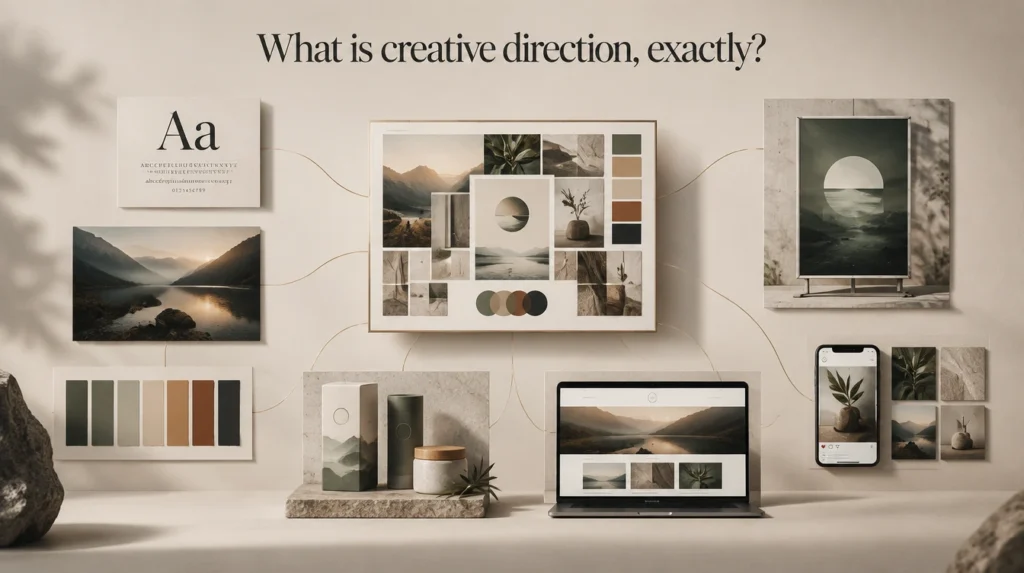
Creative direction is the leadership role and strategic practice that governs how a brand looks, sounds, and feels at every touchpoint, from a homepage to a package to a social post. It covers the creative vision, the standards that protect it, and the governance that keeps it alive. Creative direction definition in one sentence: the ongoing strategic judgment that keeps a brand’s visual and verbal expression coherent across every channel, campaign, and team. It’s the guiding idea that decides what belongs to your brand and what doesn’t, so every piece of creative work feels like it came from the same place.
Think of it as the brand’s editor-in-chief. An editor doesn’t write every article, but every article passes their judgment on whether it fits. Creative direction plays that role for your visuals, tone, and story. It’s not the logo, the photography, or the color palette themselves. It’s the decision about what all of those should express together.
And it isn’t a cage on creativity, which is the common fear. Good creative direction fixes the core, your logo, palette, type, and voice, then frees your team to move fast on everything around it. Clear limits speed people up. When designers and writers know the guardrails, they stop second-guessing and start producing.
What does a creative director actually do?
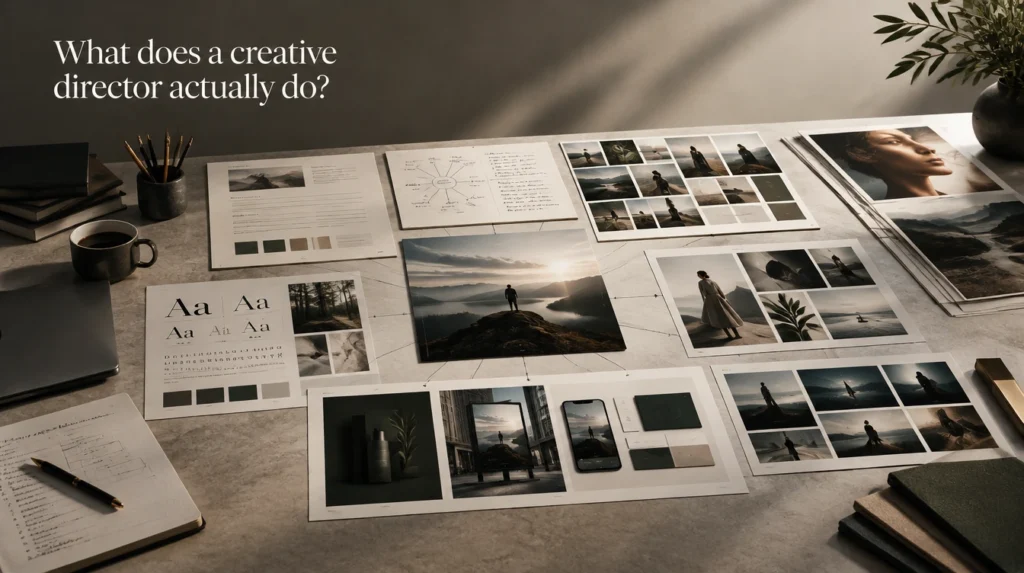
A creative director sets the brand’s creative vision, then keeps every piece of work true to it. They define the concept, brief the designers and writers, review the output against the vision, and hold the brand together as it grows across new campaigns and channels.
In plain terms, a creative director is the person who can look at any ad, page, or post and say “that’s on-brand” or “that isn’t,” and explain exactly why. They translate business strategy into a creative world, then defend that world as the team scales and the temptation to drift creeps in.
It doesn’t have to be a full-time hire. Creative direction can live as a role or as a system. A small business can have strong direction through a clear brief and a set of firm rules, without a director on payroll. What matters is that someone, or something, owns the standard.
The five core responsibilities of a creative director:
Set the creative vision. Translate brand strategy into a creative point of view that answers how the brand should look, sound, and behave. This is the north-star artifact every other decision references.
Build and enforce the brand system. Define visual identity standards (typography, color, photography direction, iconography, motion), verbal identity standards (tone of voice, lexicon, taglines), and the governance rules that keep both consistent across teams.
Brief and lead creative teams. Write briefs that designers, copywriters, art directors, photographers, and video teams can execute without confusion. Review work against the brief and the brand system, give directional feedback, and make the final creative call.
Partner with marketing and leadership. Sit between CMO, brand strategy, performance marketing, and product. Represent the creative implications of business decisions and the business implications of creative decisions.
Scale the practice without losing coherence. Decide what gets templatized, what stays bespoke, and when the brand system should evolve. Prevent the drift that happens when new agencies, hires, and channels pull a brand in different directions.
In larger US organizations, the creative director role sits at VP or SVP level and often reports to the CMO or directly to the founder. In smaller companies, it is more often a senior person who owns the vision part-time while leading other functions.
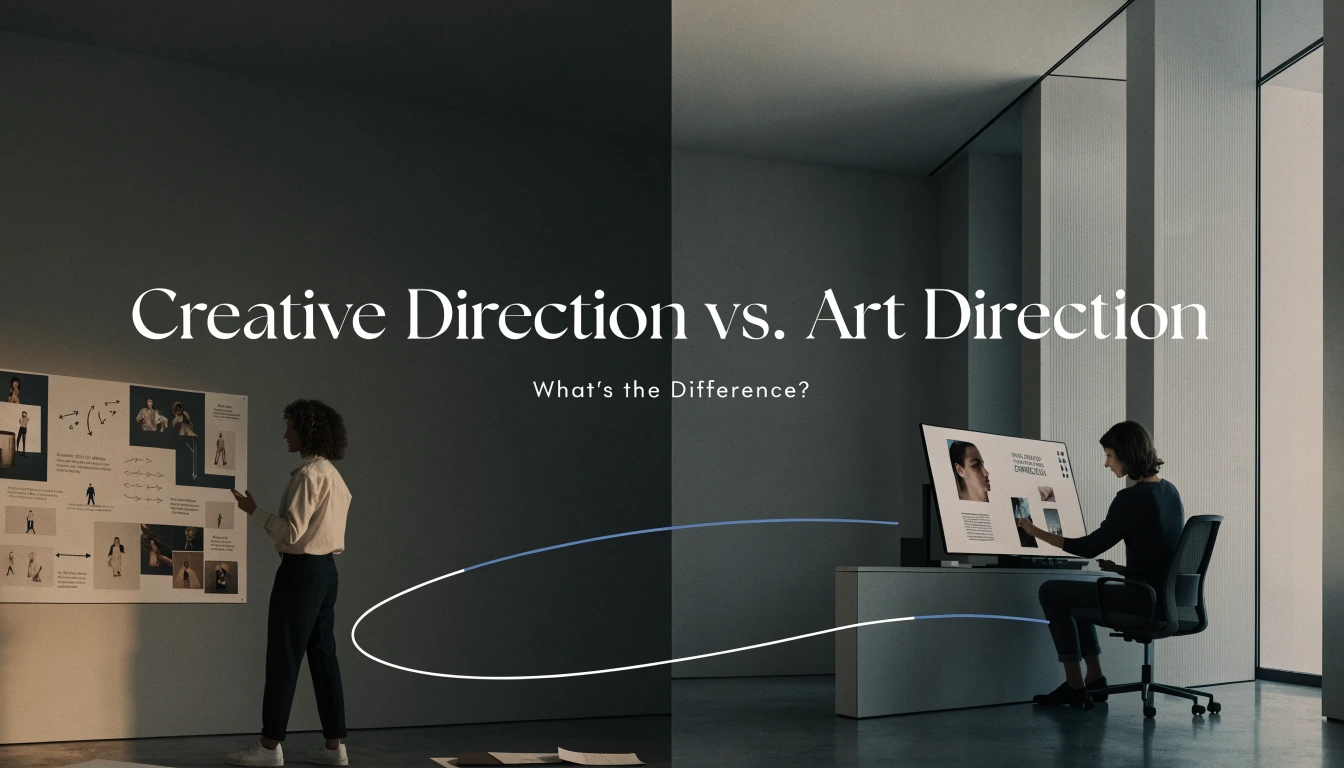
Creative direction vs. art direction, what's the difference?
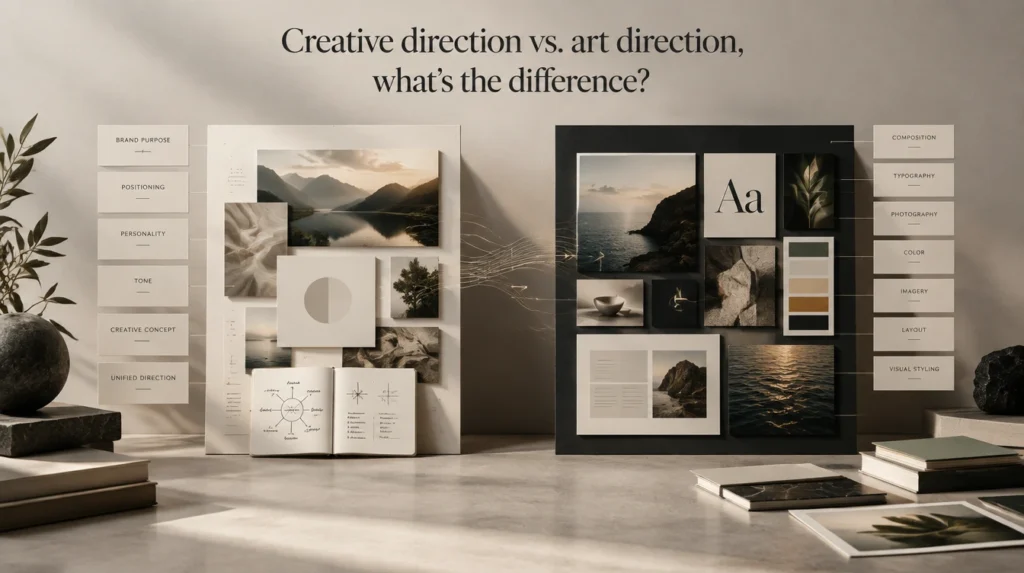
Creative direction owns the entire vision and the reason behind it. Art direction executes the visual side of that vision. One decides where the brand is going and why; the other decides how a specific piece looks to get there. They overlap, which is why people mix them up, but the scope is different.
Dimension | Creative direction | Art direction |
Scope | The whole brand vision | The visual execution |
Question it answers | What should this brand feel like? | How should this piece look? |
Covers | Visuals, tone, story, concept | Layout, imagery, typography, color |
Output | The guiding creative vision | Finished visual work |
Seniority | Sets the direction | Executes within it |
Here’s the short version. Creative direction picks the destination and the reason for the trip. Art direction drives one leg of the route. You need both, but only one of them sets the standard everything else answers to.
Creative direction vs creative strategy: what’s the difference?
Creative direction and creative strategy are often confused but they operate at different layers. Creative strategy decides what the creative work should do. Creative direction decides how it looks, sounds, and feels doing it.
Creative strategy is the upstream discipline. It answers: What is the business problem this creative needs to solve? What audience insight will the work land on? What message will move that audience? What role does this campaign play in the brand’s broader arc? Creative strategy produces the brief rooted in brand strategy.
Creative direction is the downstream discipline. It answers: How should this brief be expressed? What visual and verbal choices will carry the message? What production approach, art direction, tone, and format will land it? Creative direction produces the execution.
Creative strategy focuses on insight, audience, message, and campaign role. It outputs the strategic brief and campaign hypothesis, and typically sits with a creative strategist, planner, or strategy director. Creative direction focuses on vision, aesthetics, tone, and system coherence. It outputs the creative concept, visual and verbal standards, and approval of final work, and typically sits with a creative director or VP of creative.
Good brands run both. Creative strategy without creative direction produces smart briefs that execute as generic work. Creative direction without creative strategy produces beautiful work that doesn’t move the business. The two disciplines must sit next to each other, briefing and challenging one another before work goes into production.
Why does creative direction matter for brands?

Creative direction matters because coherence sells, and incoherence quietly costs you. When a brand looks and sounds the same everywhere, people recognize it, remember it, and trust it. That recognition compounds into revenue.
Research links consistent brand presentation to a revenue lift of around 23%, based on Lucidpress and Demand Metric survey data, with later studies putting it as high as 33%. Treat that number as directional rather than audited, since it comes from marketer surveys. But every version of the research points the same way, and buyer behavior backs it up. Roughly 8 in 10 consumers expect a consistent experience across a brand’s channels, per Salesforce. Give them a different brand on Instagram than on your website, and you spend trust you worked to earn.
The bigger problem is the enforcement gap. About 95% of companies have brand guidelines, yet only 25 to 30% actually enforce them. Guidelines sitting in a folder nobody opens are decoration. Creative direction is the enforcement, the active work of making the rules hold across every piece the brand ships. That’s the difference between owning a standard and living by one.
Wondering whether your brand looks like one company or five? A benchmarked growth audit shows where your creative is losing coherence, and revenue, using your own channels. |
What is the creative direction process? (Step-by-step)
The creative direction process is a repeatable sequence that turns brand strategy into executed creative work. Most mature brands run a six-step process:
- Discovery and audit. Review the existing brand strategy, visual identity, messaging, and creative output. Audit how the brand currently shows up across channels, where it drifts, and what competitors are doing. Interview stakeholders to surface friction points.
- Strategic foundation. Lock down the brand’s positioning, audience, personality, and creative principles. Creative direction without a strategic foundation produces beautiful work that doesn’t convert. This step defines the creative north star.
- Vision and mood definition. Build the creative vision through mood boards, reference work, aesthetic principles, verbal identity examples, and the one-line articulation of how the brand should feel. This is the artifact every downstream decision references.
- System and standards design. Codify the vision into executable standards: typography scale, color system with hex values and usage rules, photography direction with sample shots, illustration style, motion principles, verbal tone rules with do and don’t examples, and asset templates.
- Rollout and application. Apply the system to flagship assets first: website hero, launch campaign, pitch deck, packaging, hero video. These become the reference library teams copy from. Train internal teams and agency partners on the system.
- Governance and evolution. Run weekly or biweekly creative reviews. Enforce the system without making it rigid. Evolve it quarterly based on what’s working, what’s breaking, and what the brand is becoming. Document every meaningful decision.
Most brands break this process by skipping step 1 (discovery) or step 6 (governance). Skipping discovery produces a creative vision disconnected from the business. Skipping governance produces a brand that looked coherent at launch and fragmented 18 months later.
What strong creative direction actually delivers
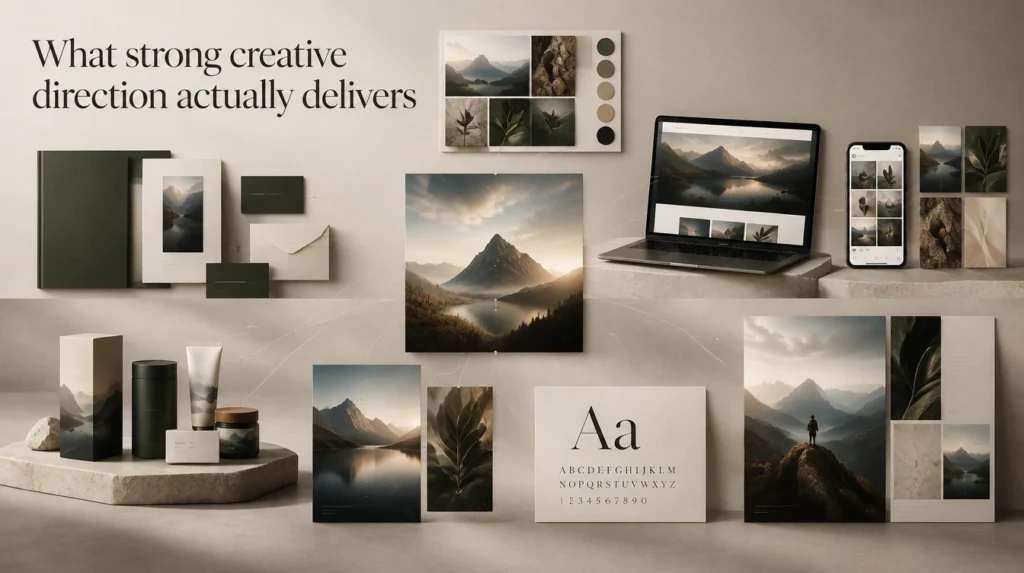
Good creative direction pays off in four concrete ways, not vague “brand feels” that never show up in the numbers. Each one traces back to the same root: a brand that behaves like one intentional thing instead of a pile of separate projects.
Consistency across every channel
Your website, your ads, your packaging, and your emails all feel like the same brand. A buyer who sees your Instagram then lands on your site gets a smooth handoff, not a jarring one that makes them wonder if they’re in the right place.
Faster creative work
When the direction is set, your team decides less from scratch. A designer with clear guardrails produces more and revises less, because the big questions are already answered. Speed is a direct output of clarity.
A stronger emotional connection
A coherent brand feels intentional, and intentional feels trustworthy. Buyers read consistency as competence. A brand that looks put-together everywhere earns belief that a scattered one has to keep re-earning.
Real differentiation
A distinct creative world is genuinely hard to copy. Competitors can match your price or your product, but a strong, specific creative identity built over time is far tougher to replicate. It becomes a moat that widens the longer you hold it.
How creative direction connects to brand strategy and performance
Creative direction sits in the middle of a stack. Brand strategy decides what you stand for. Creative direction decides how that looks and feels. Performance media puts it in front of the right buyers. Pull any layer out and the others weaken, because the work stops pointing in one direction.
At Morphiaas USA, a performance marketing agency serving businesses across the United States, we build the whole stack as one system. Our creative design work shapes the direction and the assets that express it, grounded in the positioning our brand strategy work defines. For the foundation beneath it all, our guide on what brand strategy is and why it drives growth covers the layer creative direction expresses.
What is the role of creative direction in branding, advertising, and campaign development?
Creative direction in branding defines the brand’s visual and verbal identity and keeps it consistent as the brand grows. Creative direction in advertising ensures every campaign extends the brand rather than diluting it. Creative direction in campaign development translates a creative concept into a system of assets that work across channels without losing the idea.
In branding: creative direction owns the identity system (logo, typography, color, photography, tone of voice) and the governance that keeps it coherent. It decides whether a new sub-brand, product line, or market needs its own expression or should inherit the parent system.
In advertising: creative direction leads the concept phase of every campaign, approves the creative route before production, and makes sure the campaign idea connects to the brand strategy. It prevents the common failure mode where a campaign wins awards but doesn’t help the brand.
In campaign development: creative direction orchestrates how one campaign idea extends across hero video, static ads, out-of-home, influencer briefs, PR assets, retail, and performance creative. It decides what adapts across channels and what stays fixed.
Practical examples of creative direction in brand campaigns:
Apple’s “Shot on iPhone” campaign demonstrates creative direction done well. One core idea (user-generated images and video elevated to billboard-grade production) extends consistently across out-of-home, digital, print, and in-store. The visual language is fixed: full-bleed imagery, minimal Apple wordmark, product name and photographer credit. Every execution is instantly recognizable. Creative direction defined the rules; different creative teams produced the work.
Liquid Death positions a canned water brand against the beverage category through consistent creative direction: metal and horror aesthetics, edgy copy, irreverent tone, premium can design. The creative system is strong enough that a limited-edition drop, a social post, and a 30-second spot all feel unmistakably Liquid Death. The brand built a billion-dollar valuation on creative direction as its primary differentiator.
Airbnb’s “Belong Anywhere” era used creative direction to shift the brand from a budget travel platform to an experience brand. Photography direction moved from amateur property shots to editorial travel imagery. Copy moved from functional to emotional. The symbol system (the Bélo) was built to extend across every surface. The creative direction change preceded the business repositioning.
Patagonia maintains creative direction so consistently that the brand reads as the same brand across a 40-year arc. Photography stays reportorial and environmental. Copy stays activist and plain-spoken. Product shots stay utilitarian. A new product drop today sits beside a 1995 catalog image and the system is unmistakable. Creative direction, held steady across decades, becomes the brand’s moat.
Frequently asked questions
How does creative direction work?
Creative direction works by defining the brand’s creative vision upfront and then enforcing it through briefs, reviews, and governance. A creative director sets the visual and verbal standards, writes briefs that translate business goals into creative tasks, reviews work against the standards, and approves or redirects it. The system runs on three pillars: a clear brand vision document, a review cadence that catches drift early, and one decision-maker who owns the final creative call. Without all three, creative direction produces inconsistency, slower work, and brand dilution.
What’s the difference between creative direction and branding?
Branding is the full identity: your name, logo, colors, and what you stand for. Creative direction is the vision that decides how all of that gets expressed consistently across every touchpoint. Branding is what the brand is; creative direction is how it consistently shows up in the world.
What is the meaning of creative direction in simple terms?
The creative direction meaning in simple terms: it is the role and practice of deciding how a brand looks, sounds, and feels, and then making sure every piece of work the brand produces lives up to that decision. It covers the vision (what the brand should feel like), the standards (the rules that protect that feeling), and the governance (the reviews and decisions that keep the standards alive).
Do small businesses need creative direction consulting or can they do it in-house?
Small businesses can run creative direction in-house with a clear brief, firm rules, and one owner who enforces them. Creative direction consulting makes sense when the business is scaling past 20 employees and the founder can no longer own every creative decision, the brand is entering a new market or vertical that needs a fresh creative system, or an acquisition or rebrand requires senior creative judgment the team doesn’t have. Expect creative direction consulting engagements in the US to run USD 15,000 to USD 50,000 for a defined project and USD 8,000 to USD 25,000 per month on retainer, depending on scope and seniority.
How is creative direction different from a brand style guide?
A style guide is the written record of creative direction decisions, the rules on paper. Creative direction is the living vision and the active judgment that produced those rules and keeps applying them. The guide documents the direction; it isn’t the direction itself.
How do you build creative direction from an existing brand?
Start with an audit of the existing brand: what works, what drifts, what is non-negotiable, and what the brand has outgrown. Then codify the implicit decisions the brand has already been making (type choices, color discipline, tone patterns) into explicit standards. Only add new creative direction where the brand genuinely needs it: new markets, new product categories, new audiences. The mistake most brands make is throwing out the equity they already have and rebuilding from scratch. Good creative direction from an existing brand protects what customers already recognize and sharpens what is weak, in that order.
If your brand looks different everywhere buyers find it, coherence is the fix, and it’s worth real revenue. Get a benchmarked growth audit and a plan you keep whether or not we work together. |
Morphiaas USA · 1-281-413-0382 · hello@morphiaasusa.com · 1502 Utah St, Houston, TX


What do you think?
[…] vision our brand strategy work defines. For the full breakdown of the senior layer, our guide on what creative direction is and why it matters goes deeper on the role […]
Comments are closed.