
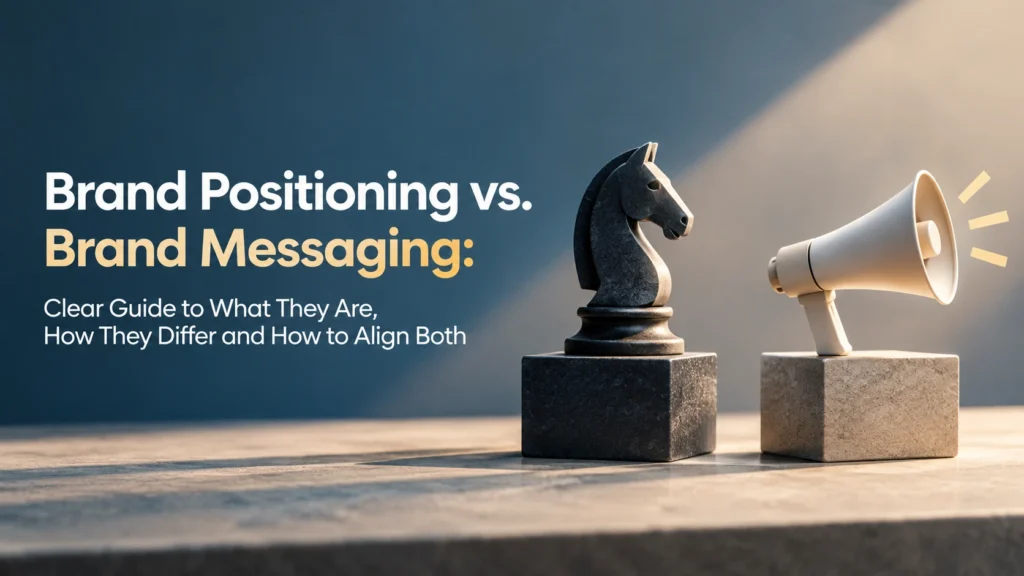
Brand positioning vs brand messaging is the difference between the space you own in a buyer’s mind and the words you use to communicate it. Positioning is the strategic foundation: internal, stable, and focused on why you’re different. Messaging is the external expression: the copy, taglines, and campaigns that adapt by audience to prove that position.
Key takeaways
|
What is brand positioning?
Brand positioning is the deliberate space your brand occupies in the market and in your buyer’s mind relative to competitors. It answers who you’re for, what problem you solve, and why you’re the choice over alternatives. It’s internal, foundational, and it guides every decision downstream. Positioning is strategy, not copy.
The simplest way to hear it: positioning is your answer to “why you, and not them?” A B2B example makes it concrete. “The only analytics platform built for enterprise retail operations” is a positioning statement. It’s a strategic declaration of the territory you defend. It rarely changes, because the whole point is that it holds still long enough for buyers to remember it.
What is brand messaging?
Brand messaging is how you communicate your positioning to your audience through specific language. It’s the value propositions, key messages, tone of voice, taglines, headlines, and the copy across your website, ads, and content. If positioning is what you stand for, messaging is how that gets said out loud, everywhere buyers meet you.
Messaging is the voice, and unlike positioning, it flexes. Your finance buyer hears about ROI and efficiency. Your operations buyer hears about usability and rollout speed. Same position underneath, different words on top. That’s messaging doing its job: translating one fixed idea into language that lands with different people at different moments.
Brand positioning vs. brand messaging: what's the core difference?
The core difference is strategy versus expression. Positioning defines the territory; messaging communicates it. One is the decision, the other is the delivery. Confuse them and you end up polishing a copy on top of a strategy nobody actually settled on, which is the most common branding mistake we see.
Dimension | Brand positioning | Brand messaging |
Question it answers | What do we want to own in the buyer’s mind? | How do we communicate that across audiences? |
Nature | Strategic, foundational | Tactical, expressive |
Audience | Internal, aligns the team | External, speaks to buyers |
Stability | Rarely changes | Adapts by audience and channel |
Output | A positioning statement | Copy, campaigns, taglines, content |
Job | Differentiate in the market | Engage and convert the audience |
Read the table one way and it clicks: every messaging column is an expression of a positioning column. The message is downstream. Always.
Why does the difference actually matter for growth?
It matters because getting the order wrong wastes money. When positioning is fuzzy, messaging turns into a rotating cast of clever lines that never compound, and buyers can’t tell what you are. When positioning is sharp, messaging gets easier to write and consistent by default, which is where the revenue shows up.
The data backs the consistency payoff. In a Lucidpress survey, 32% of marketing professionals said consistent messaging drove revenue growth above 20%. Broader analyses put the revenue lift from consistent brand presentation in the 23% to 33% range. And NielsenIQ analysis found brands with a consistent strategy are roughly 3.1 times more likely to lead their category in market share. None of that is possible if the messaging keeps contradicting itself because the position underneath was never nailed down.
Here’s the failure mode in plain terms. If your ads promise an enterprise-grade outcome but your sales calls drop into a generic feature dump, the trust you paid to build evaporates on the call. That’s not a copy problem. It’s a positioning problem leaking into the messaging.
Not sure whether your problem is the position or the words? A benchmarked growth audit pinpoints which layer is costing you conversions, using your own numbers. |
Which comes first, positioning or messaging?
Positioning always comes first. It’s the foundation the messaging is built on, so you can’t write messaging that means anything until the position is decided. Trying to reverse the order, writing catchy copy and hoping a strategy emerges from it, produces brands that sound polished and say nothing.
Think of it as a two-step sequence. Step one, decide the strategic position: who you’re for and why you win. Step two, build the messaging architecture that expresses it across audiences and channels. Skip step one and step two has no anchor. And because positioning rarely changes while messaging evolves constantly, the foundation has to be poured before the walls go up.
How do you align messaging with your positioning?
You align them by treating positioning as the brief every message answers to. Start from the positioning statement, build message pillars from it, then pressure-test all your copy against it. Anything that doesn’t reinforce the position gets cut or rewritten, no matter how clever it sounds.
- Lock the positioning first: one defensible sentence on who you’re for and why you’re different.
- Build message pillars: three to five core themes that prove the position, each tied to a real buyer pain point.
- Write to the buyer, not the boardroom: translate each pillar into language your actual customer uses.
- Enforce consistency across channels: the same position, expressed appropriately for each platform and audience.
- Audit regularly: check that live copy still ladders back to the position as campaigns pile up.
At Morphiaas USA, a performance marketing agency serving businesses across the United States, we treat positioning as the source and messaging as the system that expresses it. Our brand strategy work defines the position and the message architecture, then our performance media program puts that message against real budget and reports back to revenue.
Frequently asked questions
Is brand messaging the same as a tagline?
No. A tagline is one small piece of your messaging, the short public phrase that captures your brand. Messaging is the whole system: value propositions, key messages, tone of voice, and the copy across every channel. The tagline sits inside the messaging, not the other way around.
Can you change your messaging without changing your positioning?
Yes, and you should, often. Messaging is meant to evolve with your audience, channels, and market conditions while the underlying position stays fixed. You can refresh campaigns, taglines, and copy freely as long as they all still express the same core position.
Can you change positioning without changing messaging?
No. If you change your positioning, your messaging has to be rebuilt to express the new position, because messaging is the expression of where you sit in the market. A positioning shift that leaves the old messaging in place creates a brand that contradicts itself.
Is positioning internal or external?
Positioning is primarily internal. The positioning statement exists to align your team and guide decisions; it usually never appears publicly word-for-word. Messaging is the external, customer-facing expression of that internal position, which is the part your audience actually reads and hears.
Which matters more for conversions, positioning or messaging?
Both, but in sequence. Positioning determines whether you’re targeting the right space at all, and messaging determines whether the right people are persuaded once they arrive. Strong messaging on weak positioning converts the wrong audience efficiently, which still loses. Get the position right first, then optimize the message.
If your copy keeps changing but conversions won’t move, the position underneath is usually the culprit. Get a benchmarked growth audit and a plan you keep whether or not we work together. |
Morphiaas USA · 1-281-413-0382 · hello@morphiaasusa.com · 1502 Utah St, Houston, TX