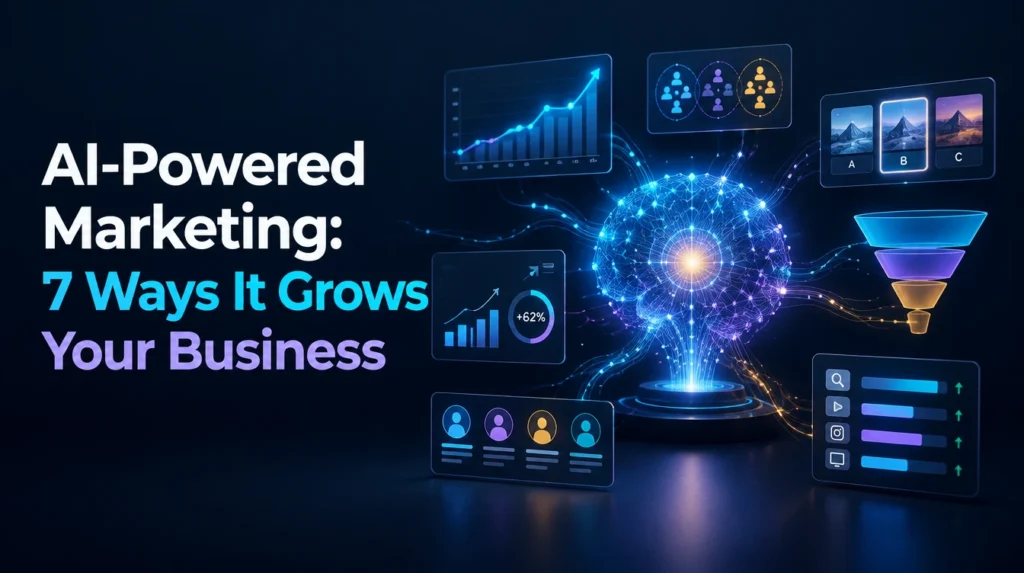
AI-powered marketing uses machine learning, generative AI, and predictive analytics to make decisions in real time. US businesses adopting it report lower acquisition costs, higher return on ad spend, and conversion rates that compound month over month. The 7 mechanisms below show how that growth gets built.
Key Takeaways
- AI-powered marketing is a stack of four technologies working together, not a single tool you buy.
- Companies using AI across marketing functions see a 35% average ROI improvement, according to McKinsey Digital 2026 benchmarks.
- The three highest-impact uses are paid-media optimization, personalization at scale, and predictive lead scoring.
- The failure mode that kills results is over-automation without human review of brand voice and strategy.
What is AI-powered marketing in one sentence
AI-powered marketing is the application of artificial intelligence to plan, run, and measure marketing activity, so decisions get made faster and personalization scales beyond what a human team can manage alone. Morphiaas USA, a performance marketing agency serving businesses across the United States, treats it as four technologies working together.
Here’s what each technology does in plain terms.
- Machine learning finds patterns in your first-party data a human analyst would miss.
- Generative AI drafts content variants, briefs, and campaign outlines at scale.
- Predictive analytics forecasts conversion likelihood, churn risk, and media response.
- Natural language processing powers chatbots, search intent analysis, and sentiment reads.
Marketing automation isn’t the same thing. Automation runs if-this-then-that rules you set once. AI-powered marketing writes new rules every time it sees new data. Data-driven marketing sits in the middle, with humans still doing the heavy analysis.
One honest note before we go further. Buying an AI tool is not an AI strategy. We’ve watched teams spend $8K on a platform that then gets logged into twice a quarter. The tool matters less than the operating model around it.
Why has AI-powered marketing become essential in 2026
Three forces turned AI-powered marketing into standard practice this year rather than an edge. Customer discovery is shifting to AI-powered search surfaces. Buyers now expect personalized experiences at every step. Paid-media costs keep climbing, so manual optimization can’t keep up with the data volume.
AI search surfaces intercept queries before the blue links get a chance. Perplexity, ChatGPT, and Google AI Overviews answer the question in place, so the page that gets cited earns the click. Teams that structure content for these engines show up in the answers.
Personalization is table stakes now. Per HubSpot research cited by Genesys Growth, 75% of marketing leaders whose organizations invested in AI report positive returns, with only 4% experiencing negative ROI. The upside is proven, the downside is small.
Paid-media costs climb every year. We watched a Houston dealership account’s auction competition rise 23% in six months. AI-driven bid logic kept cost per lead flat while slower competitors absorbed the increase on manual campaigns.
Here’s the part that changes the math. The 2026 benchmark isn’t whether you use AI. It’s whether your competitors use it better. First-mover edge decayed fast once Meta and Google baked AI into every ad surface.
How does AI-powered marketing actually help a business grow
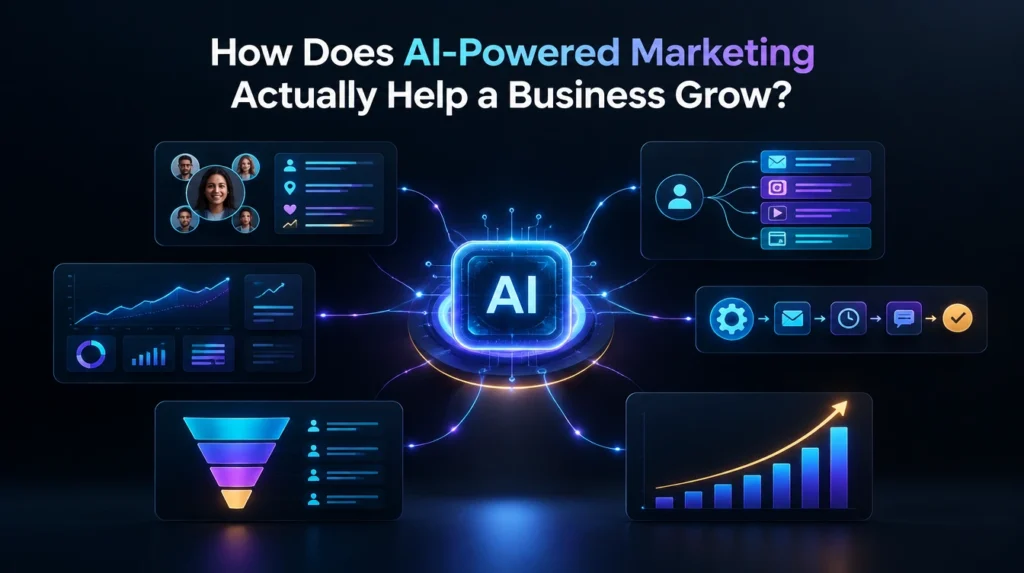
AI-powered marketing helps businesses grow through seven measurable mechanisms that stack together. Faster decisions, lower cost per lead, higher conversion rates, content velocity, predictive scoring, lifecycle retention, and clearer attribution. Each shows up on a line item a CFO can audit. The compounding effect across all seven is where real revenue sits.
1. Faster decisions. A human analyst can scan maybe 15 variables a day. AI reads thousands continuously, so pattern shifts get caught before they cost you money.
2. Lower cost per lead. AI media optimization combines creative testing, audience signal, and bid logic in one feedback loop. CPL (cost per lead) is the dollar amount you pay for one qualified inquiry.
3. Higher conversion rates from personalization. Dynamic content tuned to the viewer lifts CR (conversion rate), because the message meets the moment the viewer is in.
4. Content velocity without proportional headcount. Generative AI drafts variants, briefs, and outlines, so a two-person team ships what a six-person team used to.
5. Predictive lead scoring. Machine learning trains on actual close data, so sales teams work the top decile instead of chasing stale form fills.
6. Lifecycle retention. Churn-prediction models flag at-risk accounts before they lapse. Win-back sequences fire when likelihood of save peaks, not six weeks later.
7. Attribution that holds up to a CFO. ROAS (return on ad spend) is revenue divided by media spend. CAC (customer acquisition cost) is total growth spend divided by new customers. AI stitches multi-touch journeys so these numbers reflect reality.
A Houston DTC fashion brand we worked with moved monthly revenue from $2,079 to $21,703 in one quarter. Conversion rate climbed from 0.30% to 1.37%. The lever wasn’t a bigger budget. It was AI-driven segmentation stacking with personalized creative and lifecycle sequencing.
What does AI-powered marketing look like at each funnel stage
AI-powered marketing shows up differently at every funnel stage. Awareness runs on predictive audience modeling and AI creative testing. Consideration leans on personalization engines and lead scoring. Conversion depends on AI bid logic and dynamic landing pages. Retention runs on churn prediction and lifecycle automation. Each stage compounds into the next.
The real power sits in the compounding. Teams that fix only one stage see one-time gains. Teams that build AI into all four stages see revenue growth that holds through market shifts. Here’s how each stage breaks down, with the Morphiaas USA service that handles it and the metric that proves it’s working.
Funnel stage | Primary AI application | Morphiaas service | Metric to watch |
Awareness | Predictive audience modeling, AI creative testing | Performance Media | CPM, reach quality |
Consideration | Personalization engines, lead scoring | Growth, Technology & AI | Qualified lead rate |
Conversion | AI bid logic, dynamic landing pages | Performance Media | CPL, conversion rate |
Retention | Churn prediction, lifecycle automation | Growth, Technology & AI | Churn %, CLV |
At the awareness stage, our performance media program tests creative variants in micro-cohorts, so losing concepts die inside a day instead of a week. At consideration, predictive scoring routes high-intent leads to sales teams the hour they engage. At conversion, dynamic landing pages adjust to source traffic. At retention, lifecycle sequences fire on behavior, not on calendar.
A better awareness audience costs less to convert. A better conversion experience lifts CLV. A better retention loop lowers CAC on your next cohort. Neglect one stage and the whole chain drags.
How is AI-powered marketing different from traditional marketing
The main differences are speed, personalization depth, and who does the work. Traditional marketing runs on human analysis cycles and campaign-level targeting. AI-powered marketing runs on real-time pattern recognition and individual-level targeting. The output of a traditional team scales linearly with headcount. The output of an AI-equipped team scales with data volume.
Dimension | Traditional marketing | AI-powered marketing |
Decision cycle | Weekly or monthly | Continuous, real-time |
Personalization | Segment-level | Individual-level |
Cost at scale | Rises with headcount | Rises with data volume |
Testing capacity | 2 to 4 variants per campaign | 50+ variants in parallel |
Attribution | Last-click or first-touch | Multi-touch, incrementality-weighted |
Who does the work | Analysts and media buyers | Hybrid team plus models |
Pure-AI setups fail because the models need a human to tell them what good looks like. Pure-manual teams fall behind because they can’t match the testing throughput. The hybrid shape wins. We build client teams where humans own strategy, brand, and judgment calls. The models own repetition, measurement, and real-time response.
The split matters more than the tooling. A team that stays strategic while handing execution to AI ships more growth than a team using the same tools but keeping humans on every button.
Weighing AI adoption for your business and want the ROI math modeled for your specific vertical?
What are the limitations of AI-powered marketing
AI-powered marketing fails in three predictable ways. Weak input data produces weak output. Paid-media algorithms burn budget during their learning phase before they stabilize. Generative AI drifts away from brand voice if nobody edits the output. Teams that account for these upfront get the full ROI. Teams that don’t lose money fast.
Data quality. Weak first-party data produces weak output no matter how good the model is. We watched a Dallas B2B client spend $14K on an AI scoring platform before realizing their CRM was missing deal-stage data on 60% of records. Clean the data first.
Learning phase cost. Meta Advantage+ and Google Smart Bidding each go through a learning phase, the window where the algorithm gathers conversion signal to stabilize. Short campaigns never exit learning, and the budget runs hot the whole time.
Brand-voice drift. Generative AI will write 50 captions in your approximate voice. By caption 51 it starts sounding like generic LinkedIn copy. Boosted posts are a donation to Meta. Ungoverned generative content is a donation to your competitors.
How do we know AI-powered marketing is working
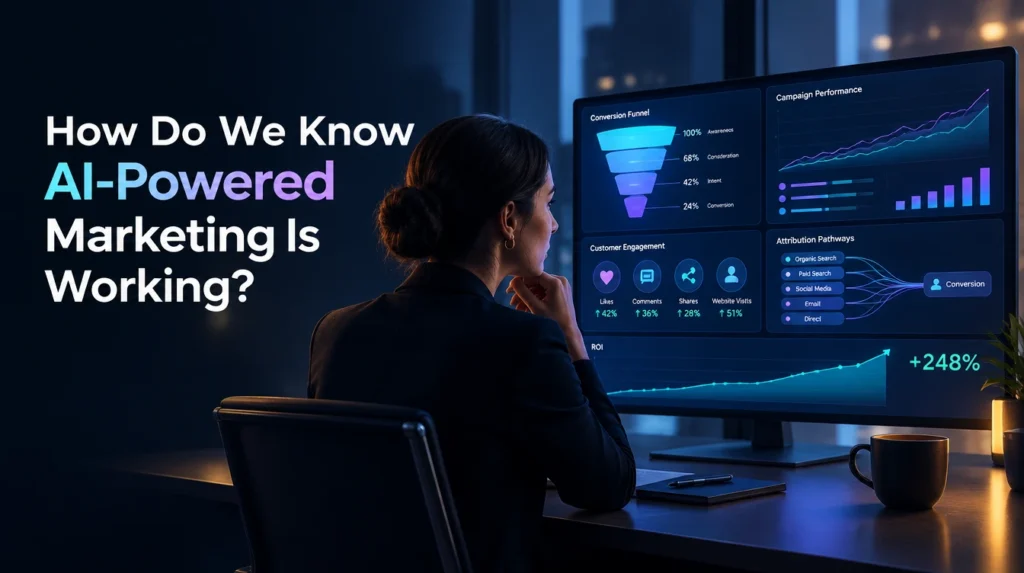
Four numbers tell you whether AI-powered marketing is actually working. ROAS shows paid-media efficiency. CAC shows the all-in cost of a new customer. CLV shows how much revenue a customer generates over their lifespan. Incremental revenue shows what the AI setup produced that wouldn’t have happened on its own.
ROAS. Divide revenue attributed to paid media by paid-media spend. A 4:1 ROAS means every dollar spent returns four. For most US e-commerce brands, 3:1 is baseline and 5:1 is strong.
CAC. Add every dollar spent to acquire customers in a window, then divide by new customers in that window. Lower is better. Watch the trend line, not the single-month number.
CLV. Average revenue per customer times average lifespan. If CLV is 3x CAC, the business is healthy. If CLV is 1x CAC, the business is burning capital.
Incremental revenue. Run holdout tests. If a cohort that didn’t get the AI-driven treatment converts at the same rate, the AI isn’t working. If the treated cohort converts higher, that lift is incremental.
These four numbers are what our AI marketing services report against. For more on how we structure measurement across accounts, see the Morphiaas USA Insights library.
FAQ
What is AI-powered marketing in simple terms?
AI-powered marketing is marketing where machine learning, generative AI, and predictive analytics make or inform most of the decisions, so personalization and optimization happen in real time instead of in weekly review cycles.
How much does AI-powered marketing cost for a small business?
Entry costs run $1K to $3K per month in tool subscriptions for an SMB stack. Managed service through an agency typically starts at $5K per month, scaling with ad spend and complexity.
Does AI-powered marketing replace marketing teams?
No. It replaces repetitive tasks, not strategic judgment. US marketing teams using AI across multiple functions typically shift one or two roles from execution to strategy rather than cutting headcount.
How fast does AI-powered marketing show results?
Paid-media AI shows results in 2 to 4 weeks once past the learning phase. Content and SEO AI compound over 90 days. Lifecycle and retention AI typically produce measurable lift in 60 days.
Which AI marketing tools are worth paying for?
Start with your native ad-platform AI (Advantage+, Smart Bidding) because it’s included. Add a personalization engine, a predictive scoring tool, and a generative AI content assistant. Buying ten tools before building a strategy is wasted money.
How does AI-powered marketing improve customer engagement?
AI reads individual behavior signals and matches content, timing, and offer to the moment. Open rates lift, click rates lift, time on site lifts. Engagement is a byproduct of relevance, and AI scales relevance.
Where this leaves US businesses
AI-powered marketing isn’t a trend you catch up on. It’s the new operating system for growth. US businesses that build their stack right compound ahead of their market. Businesses that wait pay more for every lead their competitors are getting for less. DigitalOcean’s Currents research found 69% of SMBs have already used ChatGPT for personal or business purposes, so the adoption floor keeps rising.
Morphiaas USA builds AI-powered marketing programs around receipts, not promises. ROAS you can audit, CAC you can defend, CLV you can project. If you want a benchmarked view of what AI can do for your specific vertical, book a growth audit and we’ll show you the math.
Ready to see the ROI model for your business?
Get a benchmarked growth audit