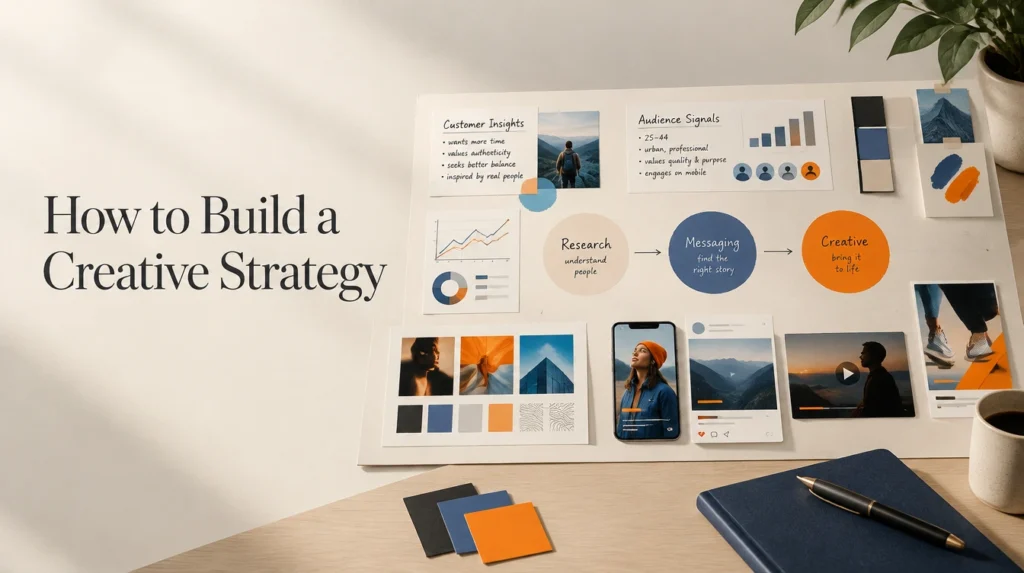
How to build a creative strategy comes down to one discipline. You refuse to make work before you know what the work has to do. Nielsen’s analysis of nearly 500 campaigns found creative quality drives 47% of advertising sales lift, more than reach, targeting, and budget combined. The rest is media math. This guide walks the full build, from first insight to executed campaign.
Key Takeaways
- Creative quality explains 47% of a brand’s sales lift from advertising, per Nielsen and NCSolutions research.
- Brand strategy decides who you are. Creative strategy decides what you say, to whom, and how it sounds.
- Every strong creative strategy starts with one sharp insight about the buyer, not a brainstorm.
- The creative brief is where strategy becomes execution. A weak brief produces weak work.
- Brands that balance brand-building and performance creative see a 90% average lift in revenue ROI, per WARC.
- Measurement closes the loop. Without it, next quarter’s creative starts cold.
What is a creative strategy, really
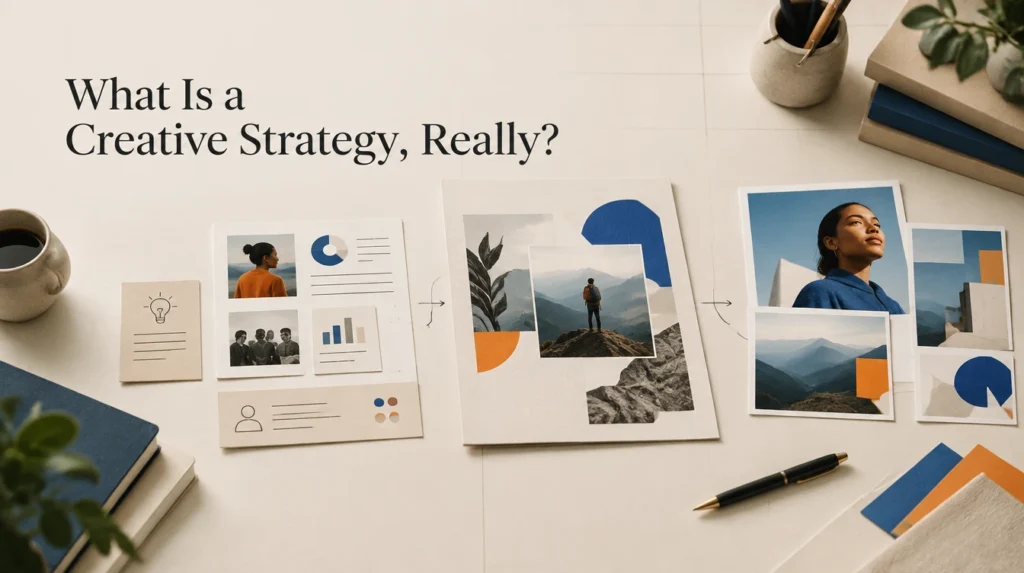
A creative strategy is the written plan that connects your business goal to every ad, page, email, and asset your audience will see. It names the audience, the shift in behavior you want, the message that will cause that shift, and the channels that will carry it. Nothing more decorative than that.
Most teams confuse creative strategy with creative output. The output is the ad. The strategy is the reason that ad exists in that form, aimed at that person, saying that specific thing. Without the strategy, you get work that looks finished and performs like noise.
Morphiaas USA, a performance marketing agency serving businesses across the United States, builds creative strategies the way an engineer builds a load-bearing frame. Every element has a job. If it does not carry weight, it comes out of the plan.
How is creative strategy different from brand strategy
Brand strategy defines who you are, what you stand for, and what you promise. It lives for years. Creative strategy decides how that identity shows up in a specific campaign, for a specific audience, in a specific moment. It evolves with the market.
Here is the clean split most teams miss.
Layer | Brand Strategy | Creative Strategy | Creative Execution |
Core question | Who are we and what do we stand for? | What do we say, to whom, and how? | What does it look and sound like? |
Lifespan | 3 to 10 years | Quarterly to annual | Days to weeks per asset |
Owner | Founder or brand lead | Strategy lead or agency partner | Creative team or production partner |
Deliverable | Positioning, guidelines, voice | Brief, messaging hierarchy, campaign idea | Ads, videos, pages, posts |
When teams skip the middle layer, every new campaign starts from scratch. Nothing compounds. The brand feels different every quarter because there is no shared creative plan holding it together.
Why creative is the biggest lever most teams underuse

The data on creative impact is settled. The Nielsen and NCSolutions analysis of around 500 campaigns found creative quality accounts for 47% of a brand’s sales lift from advertising. Media buying contributes 36%. Brand factors cover the rest. Yet most marketing teams spend more time on bid strategies than on the ads themselves.
A WARC study with Analytic Partners went further. Brands that moved from a performance-only approach to a balanced brand-plus-performance mix saw a 90% average uplift in revenue ROI. Brands that went the other way lost 40% on average, as reported in WARC’s Multiplier Effect report. Creative is the lever that connects both sides.
There is a reader-trust number worth saving too. A Celtra survey covered in Adweek found 85% of US adults are more likely to trust a brand with high-quality, well-designed ads. Design is not vanity. It is the fastest trust signal a stranger gets from your brand.
We learned this the expensive way on a dealership account. For months we optimized bids and audiences while running tired creative. CPL stayed flat. Rebuilt the creative strategy around one buyer insight, and lead costs dropped to $10.76, well below the $34.15 automotive benchmark reported by WordStream’s 2024 Google Ads benchmarks. Same budget. New creative plan.
Where real brand insights come from

An insight is not a demographic. It is a tension in the buyer’s life that your product can resolve. The job of research is to find that tension in the buyer’s own language, not in a mood board.
Four sources tend to produce usable insights:
- Customer interviews. Ten honest conversations beat a thousand survey rows. Ask what they tried before, what they were hoping it would do, and where it fell short.
- Review mining. Pull your reviews, your competitors’ reviews, and category reviews on Amazon or Google. Group by the problem being described, not the product being praised.
- Search data. The questions buyers type into Google reveal what they do not yet know, want, or trust. Google Search Console and People Also Ask are free intelligence most brands ignore.
- Sales and support logs. Your sales calls and support tickets hold the objections and the breakthroughs. These are the lines that convert, written by customers.
One insight is enough. If you have three, you probably have one real insight and two assumptions. Cut the assumptions.
How to turn an insight into a creative strategy
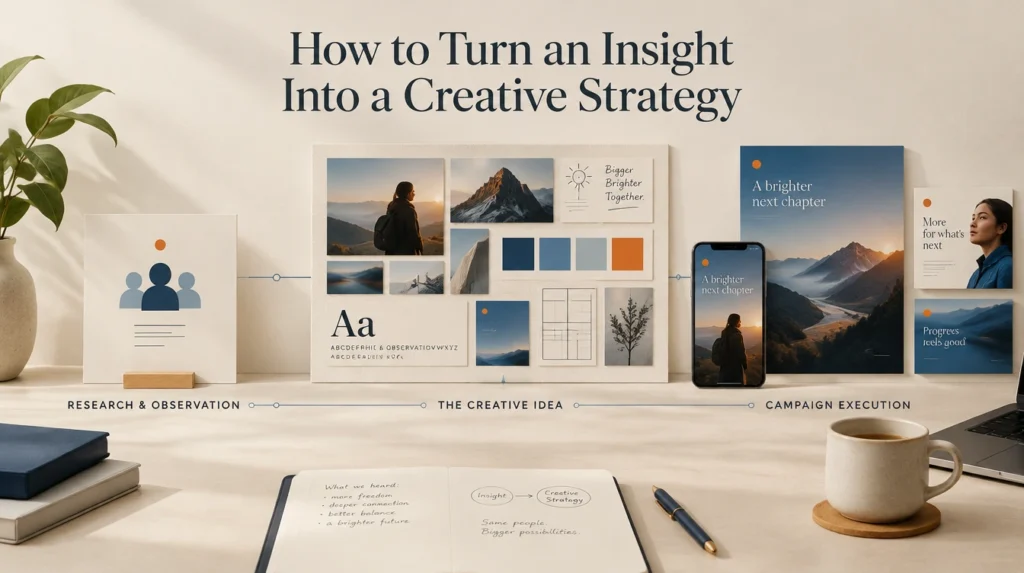
An insight on its own is a sentence. A creative strategy turns that sentence into a plan. The move happens in five steps.
- Name the business goal in a number. Not “grow the brand.” Try “move Q1 ROAS from 1.8 to 2.4” or “add 400 new customers at a CAC under $45.”
- State the audience in one sentence. Who they are, what they buy today, and what you want them to do instead.
- Write the insight as a tension. “They want X but believe Y.” That shape forces specificity.
- Pick the single most important message. If the buyer remembers one thing, it is this. Everything else supports it.
- Choose the channels and formats that fit the moment. Not every channel. The ones where the audience already pays attention, in the format they already consume.
A quick example. A DTC fashion Shopify brand we work with was running broad social creative on styling tips. The insight was that their best buyers already knew how to style; they were looking for pieces that lasted past one season. We shifted the strategy to a durability-and-fabric story. Monthly revenue moved from $2,079 to $21,703. Conversion rate climbed from 0.30% to 1.37%. Same products. Different message, aimed at the real tension.
What belongs in a creative brief that actually guides the work
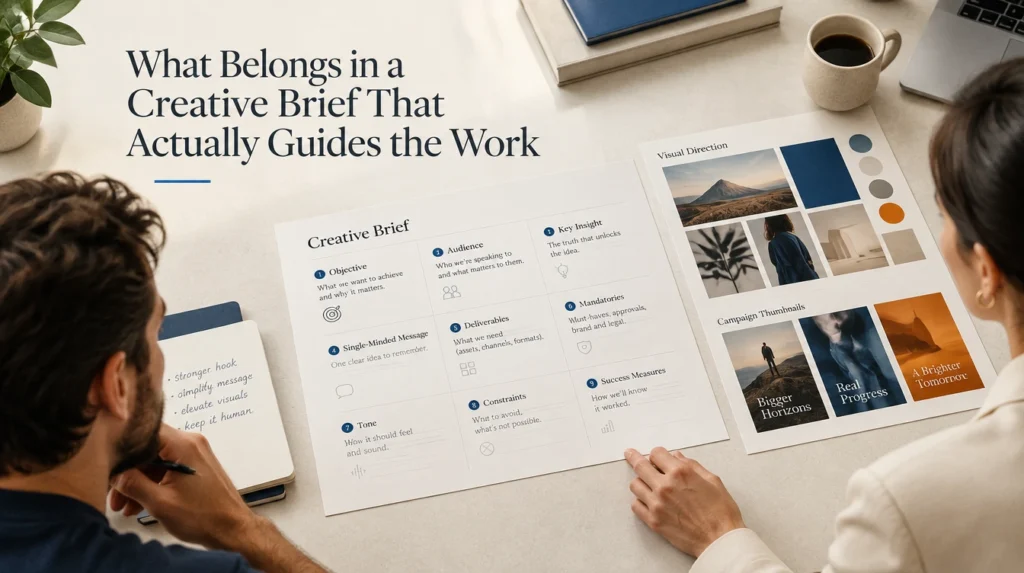
The brief is where strategy becomes execution. If the brief is vague, the work will be too. A tight brief fits on one page and answers seven questions without decoration.
- Why are we making this? The business goal in a sentence.
- Who is this for? The audience in human language, not a persona code.
- What do they currently believe? The starting point.
- What do we want them to believe or do next? The shift.
- What is the single most important message? One line, memorable.
- What proof backs it? Data, demonstrations, testimonials, guarantees.
- Where will this live and how do we know it worked? Channels, formats, metrics.
Everything else, including the mood board, is reference material. If the brief needs a glossary, rewrite the brief.
How to move from brief to executed campaign
Execution is where most strategies quietly die. The brief is strong, the first creative concepts are promising, and then four rounds of revisions sand away the edge. By launch the work is safe, generic, and underwhelming. Here is how to protect the idea.
- Set the concept bar before the first review. Pick two or three criteria the work must meet. “Is the insight visible in the first three seconds” is a real criterion. “Does it feel premium” is not.
- Produce in waves, not in one big batch. Three concepts, one winning direction, five executions in that direction. Then test. This is how performance teams build creative that compounds instead of ages out.
- Treat creative revisions as evidence, not opinion. If a change gets suggested, name the audience problem it solves. If no one can name it, the change does not ship.
- Hold a kill list. Clichés, false claims, and tired visual tropes get written down and banned by name. The list protects the work from drift.
Boosted posts are a donation to Meta. Real campaign work starts with a brief and ends with testable concepts that trace back to the insight.
How to know your creative strategy is working
Measurement is where ledger discipline meets creative. Three layers of signal matter, in this order.
In-platform performance. ROAS, CPA, CTR, hook rate, and thumb-stop ratio tell you if the creative is doing its paid-media job. These update daily and should be reviewed weekly during a campaign.
Brand lift and recall. Short brand lift studies on Meta and YouTube cost less than most people think and tell you whether the message is landing in memory. Research from Les Binet and Peter Field, surfaced across the IPA Databank, shows creatively awarded work generates 11 times more share-growth efficiency than non-awarded work. Memory is the compound-interest layer.
Business numbers. New customer acquisition, revenue, average order value, and retention. These are the receipts. If the first two layers improve but these do not, the strategy is aimed at the wrong business problem.
Review every 60 to 90 days. Shorter cycles turn into noise. Longer cycles let a weak strategy keep running past its welcome.
What kills most creative strategies before they ship
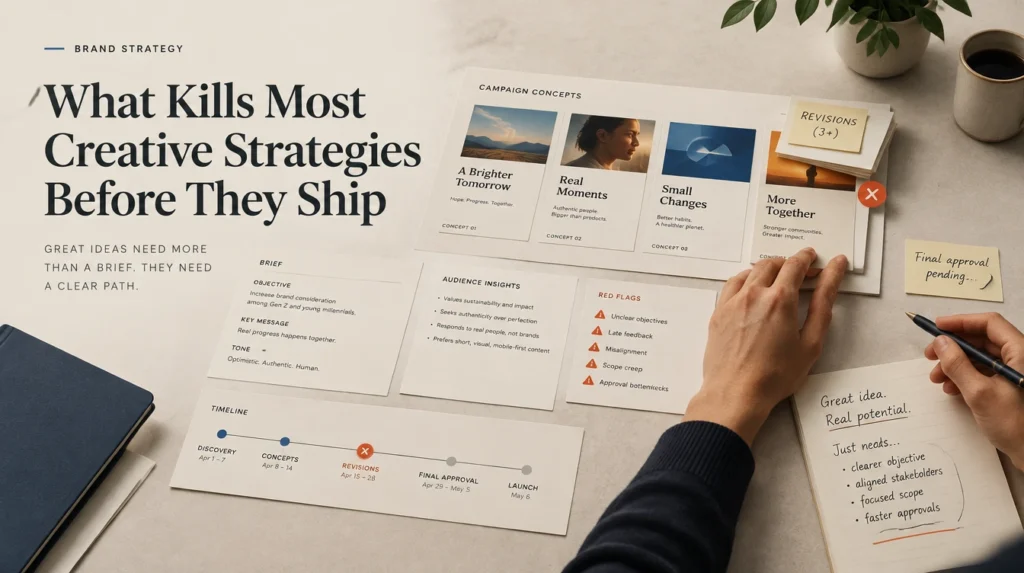
A short list, from the ones we see most:
- Research without a decision. Teams gather customer data and then revert to taste when it is time to pick a message.
- No single-most-important message. Every slide gets equal weight, so nothing lands.
- Strategy owned by one department, creative owned by another. Hand-offs lose the insight.
- Trying to cover every audience in one campaign. One strategy, one audience, one shift. Build a second strategy for the second audience.
- Confusing a brand refresh with a creative strategy. New colors do not fix a positioning problem.
If you catch two of these in your current plan, the plan needs a rebuild before more spend goes behind it.
Want someone to pressure-test your creative strategy against your numbers? We benchmark it against US category data, your paid-media performance, and the receipts your creative is or is not earning.
Common questions on building a creative strategy
How long does it take to build a creative strategy
A focused creative strategy for one audience and one campaign takes two to four weeks. The first week is insight work. The second is strategy and brief. The next one to two are concept development and first test assets. Full brand-level strategy with multi-audience segmentation runs six to eight weeks.
What is the difference between a creative strategy and a creative brief
The strategy is the plan. The brief is the single-page document the creative team uses to produce the work. The strategy decides what the campaign is. The brief tells the people making it what success looks like, who it is for, and what message must land.
Do we need a creative strategy if we only run paid social
Yes, more than teams that run everything. Paid social burns through creative fast. Without a strategy, you end up producing random tests instead of variations on a sharp idea. A strategy gives you a point of view to vary, which is what makes creative compound instead of fatigue.
How much should we spend on creative versus media
There is no fixed ratio, but a working rule for US DTC brands is 10 to 20 cents of creative production for every dollar of paid media. The exact split follows the complexity of the brief and the number of concepts in test. Growth-stage brands often sit higher because they are building the creative library that will carry them into next year.
Can we build a creative strategy without an agency
You can, especially for a single-audience campaign with a strong internal lead. Where in-house teams struggle is independent pressure-testing of the insight and benchmarking against outside creative. That is usually what an agency partner adds. The method itself is not a secret.
What is one sign our creative strategy is working
Fewer rounds of revisions, and shorter arguments about what should ship. When the strategy is clear, the brief is tight, and the insight is sharp, review meetings get fast. When they get slow and opinion-driven, the strategy is not actually written down anywhere.
Where to take this next
A creative strategy that is written, pressure-tested, and tied to a business number is one of the highest-return investments a US brand can make. The research is clear. Nielsen puts creative at 47% of sales lift. WARC puts balanced creative at a 90% ROI uplift. The question is not whether creative is worth building a strategy for. It is whether yours is.
Explore our full approach to creative design and campaign development, see where it meets brand strategy, or read more case notes in our US Insights library.
Ready to put a creative strategy behind your next quarter of growth? We will audit your current creative, benchmark it against your category, and show you where the strategy, the brief, or the execution needs to change for the number to move.