
Performance marketing is a type of paid digital advertising. You pay only after a tracked action happens: a click, a lead, a sale, an app install. The payment ties to the result, not the impression. That shifts who takes the risk and which creative gets killed.
Key Takeaways
- You pay for results, not reach. Clicks, leads, sales, and installs are the trigger.
- Four channels do most of the work: paid search, paid social, programmatic, and affiliate.
- The metrics that run an account are ROAS, CPA, CAC, LTV:CAC ratio, and conversion rate.
- The US average Google Ads cost per click is $4.66; the average search conversion rate sits near 7%.
- Performance marketing fails when tracking, creative, or landing pages are broken. The channel is almost never the problem.
What is performance marketing in plain terms?

Morphiaas USA, a performance marketing agency serving businesses across the United States, builds every campaign on one rule: if the dollar can’t be matched to a tracked outcome, it isn’t performance marketing.
The pricing models are the vocabulary. CPC (cost per click) means you pay each time someone clicks the ad. CPL (cost per lead) means you pay for a verified form fill or phone call. CPA (cost per acquisition) means you pay for a completed sale or sign-up. ROAS (return on ad spend) tells you how many dollars came back for every dollar out.
For a sense of where the baseline sits, the WordStream 2024 Google Ads Benchmarks report puts the average cost per click across all industries at $4.66, with an average click-through rate of 6.42%. Those are the numbers you negotiate against the moment a campaign goes live.
How does performance marketing actually work?
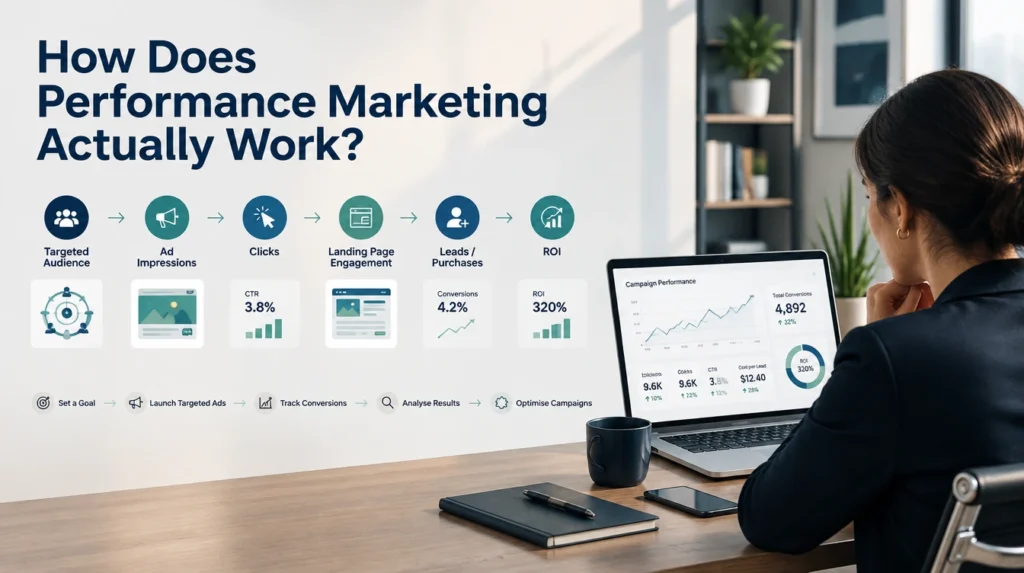
Here’s the sequence an operator actually follows:
- Lock the outcome. A sale? A qualified lead? A trial sign-up? The pixel can only optimize toward one anchor event per ad set.
- Pick the channel to match intent. Someone searching “best plumber Houston” is further down the funnel than someone scrolling Instagram at 10 pm.
- Build the measurement spine. Server-side tracking, UTM discipline, a working conversion API. Skip this and the data lies for the rest of the campaign.
- Launch, feed the algorithm, hold your fire. Most Meta and Google algorithms need about 50 conversions a week to exit their learning phase.
- Cut what loses, double what wins. By week three the account should look nothing like week one.
One blurred US receipt from a client: a Dallas DTC fashion brand on Shopify moved monthly revenue from $2,079 to $21,703 inside a quarter. The conversion rate climbed from 0.30% to 1.37%. Nothing changed about the product. The measurement spine and the creative cadence did.
Source: Morphiaas USA client campaign data.
And that’s the point. Performance marketing is less about ads and more about what gets counted.
Which channels count as performance marketing?
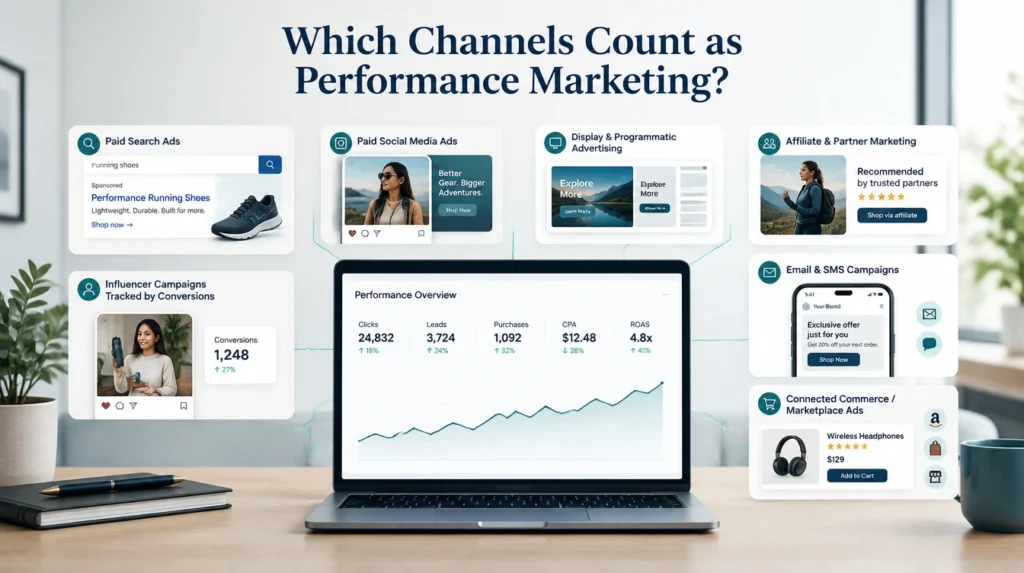
Paid search (Google Ads, Microsoft Ads). Buyers tell you what they want by typing it. Highest intent, highest CPC. Legal keywords in the US average $54.86 per click, per WordStream. If the lifetime value supports the price, you pay it.
Paid social (Meta, TikTok, LinkedIn, Pinterest, Snap). Lowest-intent at the top, best creative flexibility in the stack. Meta Ads Manager runs CPC, CPM, CPA, and conversion-API attribution out of the box.
Programmatic display and native. Retargeting lives here. Prospecting display gets harder every quarter. Watch viewability and brand safety; cheap impressions are often cheap for a reason.
Affiliate. Pay per referred sale, usually 5% to 30% commission, tracked through networks like Impact or ShareASale. Zero waste on paper. Policing fraud is the real job.
Connected TV (Hulu, YouTube, Netflix ad-tier). The newest performance channel in the US. Mostly CPM-based for now, with growing attribution back to pixel-tracked outcomes.
Retargeting and remarketing. Not a standalone strategy. A compounding layer on top of the five above.
How is it different from digital marketing and affiliate marketing?
The confusion is reasonable. SEO is digital marketing, but it isn’t performance (you pay the SEO team whether rankings move or not). An influencer post is digital marketing, but it’s only performance when the deal ties to a tracked promo code or affiliate link.
Dimension | Performance marketing | Traditional marketing | Affiliate marketing |
What you pay for | A tracked action (click, lead, sale) | Impressions, airtime, print space | A referred sale, by commission |
Measurement | Real-time, platform plus pixel | Delayed, modeled, often estimated | Network-tracked, per publisher |
Risk owner | The platform and your creative | The brand | The affiliate |
Scale control | Daily, per campaign | Media-buy cycle | Capped by publisher reach |
Here’s the test: can you point to one tracked event and say, “That’s what we paid for”? If yes, it’s performance. If the invoice is for effort, exposure, or airtime, it isn’t.
Which metrics do performance marketers actually watch?
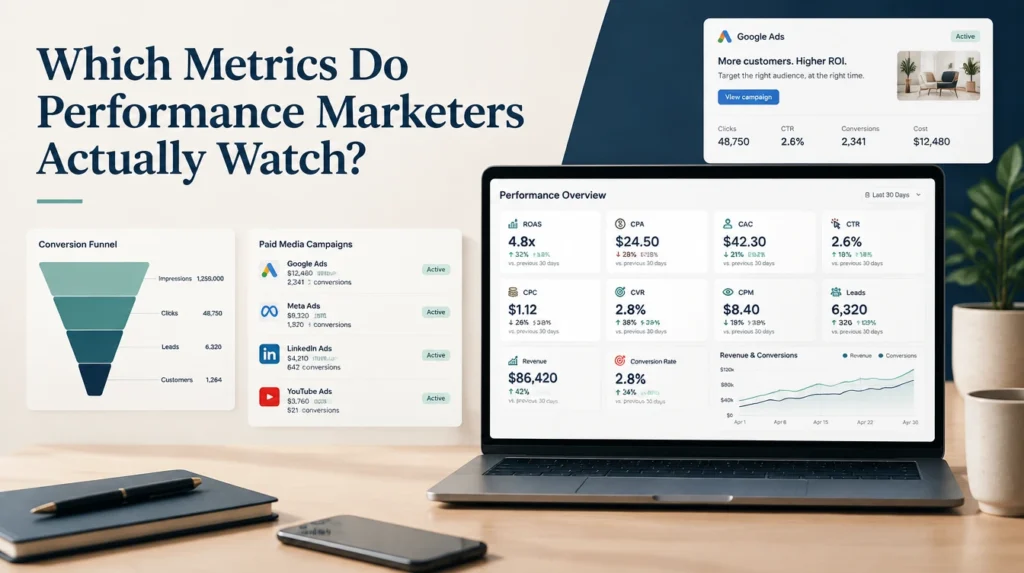
ROAS (return on ad spend) is the simplest one. Spent $1,000, generated $4,000 in attributed revenue? That’s 4:1 ROAS, or 400%. Healthy e-commerce accounts usually target 3:1 as the floor.
CPA (cost per acquisition) is what one new customer costs through this channel. The WordStream 2024 benchmarks put the average US Google Ads conversion rate near 7% across industries, which means CPA climbs fast when conversion rate drops.
CAC (customer acquisition cost) is CPA across all channels, blended. CAC alone tells you nothing. CAC against LTV (customer lifetime value) tells you if you have a business.
LTV:CAC ratio. The number investors ask about first. Three-to-one is the common target. Below two-to-one, you’re losing money on growth. You just haven’t booked it yet.
Conversion rate. The leak detector. If spend looks efficient but revenue stalls, the problem is the landing page, not the ad. Running the whole stack well is as much a Growth, Technology & AI problem as a media one.
One US dealership we ran spent its first full month at a cost per lead of $10.76. The industry benchmark for automotive on Google was $34.15 that same quarter. The gap isn’t magic. It’s the stack doing its job.
Source: Morphiaas USA client campaign data.
How much does performance marketing cost in the US?
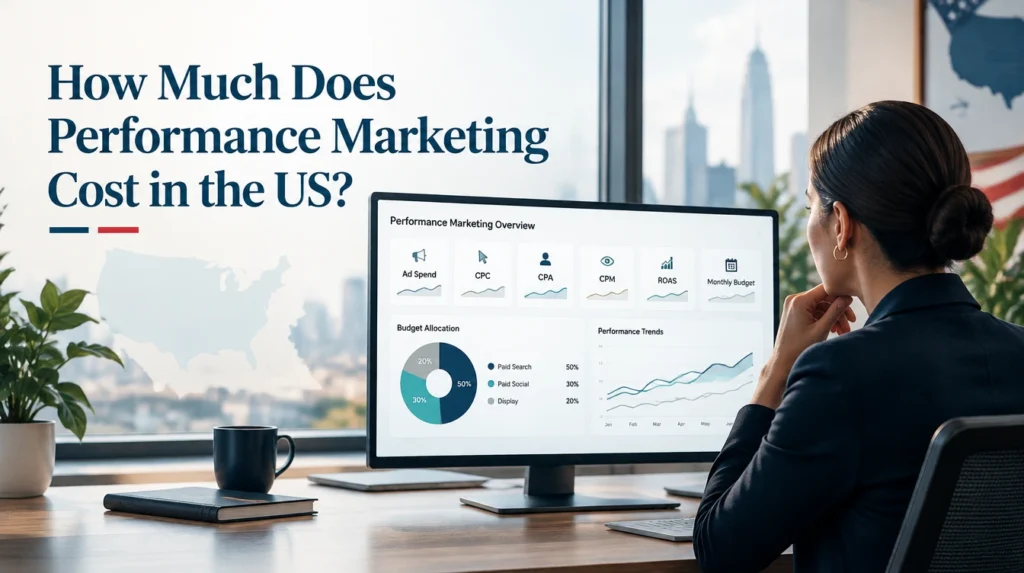
The IAB Internet Advertising Revenue Report put US digital ad spend at $294.6 billion in 2025, up 13.9% year over year. That’s the pool you compete in for attention. Prices rise with the competition.
A workable rule for a US SMB starting from zero: budget enough media spend to generate at least 50 conversions a month on your anchor event. Below that, Meta’s and Google’s learning algorithms don’t stabilize. You end up buying noise instead of signal.
For most US DTC and lead-gen businesses, that pencils to $3,000 to $15,000 a month in media, plus the people running it. Smaller gets you data. Larger gets you optimization.
We don’t publish fixed pricing because performance marketing cost depends on vertical, LTV, and measurement maturity.
Book a benchmarked growth audit
When does performance marketing actually fail?
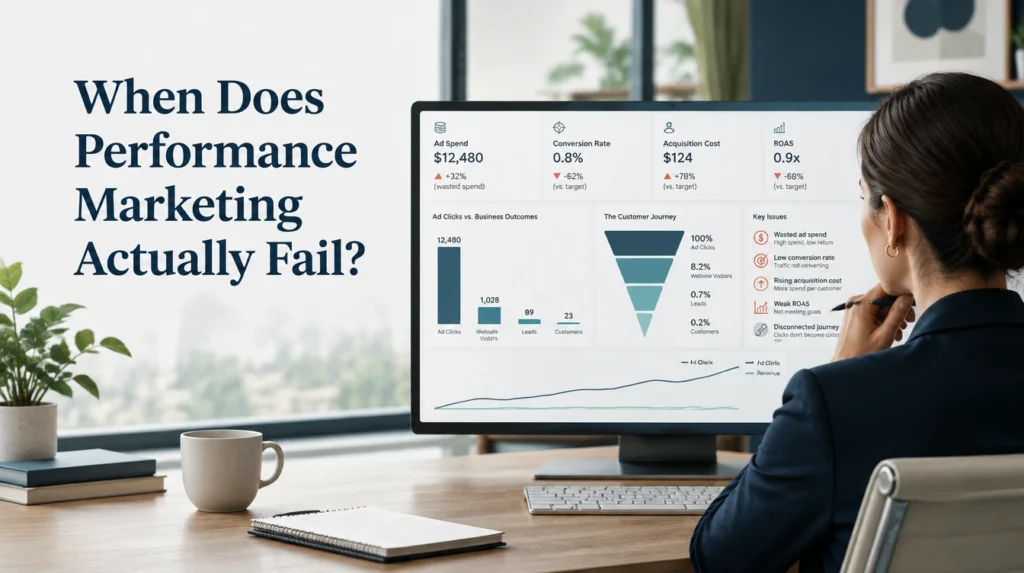
Measurement first. If your pixel double-counts, your conversion API isn’t firing, or your attribution window is set wrong, every optimization decision after that runs on fiction. Fix the plumbing before you touch the ads.
Creative second. Platforms burn budget on a dying creative because, as far as the algorithm knows, it’s the best option in the account. The job is to keep feeding fresh variants. Three to five new creatives a week is a reasonable floor for an active Meta account.
The landing page is the one most agencies won’t own. Our take: if the page doesn’t convert, the whole spend is renting Zuckerberg a yacht. Boosted posts are a donation to Meta. Working creative on a broken page is a donation with extra steps.
For how we fix each of these three in sequence, see our Performance Media program.
How do you know you're ready to run it?
Signals that say go: existing customers, repeat purchases, early reviews, a conversion event wired up correctly. The product has evidence it works, and the stack can prove it.
Signals that say wait: no analytics installed, no clear hero SKU, no cash runway to let the learning phase finish. Performance marketing compounds what already works. It doesn’t rescue what doesn’t.
If you’re close to that line, a benchmarked audit is the fastest way to find out. For more on how we structure early-stage accounts, browse the Insights library.
Frequently asked questions
Is performance marketing the same as digital marketing?
No. Digital marketing covers every form of marketing on the internet, including SEO, content, and brand campaigns. Performance marketing is the subset where payment is tied to a tracked outcome. All performance marketing is digital marketing. Not all digital marketing is performance.
Is performance marketing the same as affiliate marketing?
No. Affiliate marketing is one channel inside performance marketing. In affiliate, third-party publishers earn commission for driving a sale through their link. Performance marketing is the whole category, which also includes paid search, paid social, programmatic, and connected TV. Affiliate is a slice; performance is the pie.
How fast does performance marketing show results?
Click and spend data show up in hours. Reliable optimization data needs the platform to pass its learning phase, which usually requires about 50 conversions per ad set per week. For most US accounts, that means a 30- to 60-day window before results stabilize enough to trust.
Does performance marketing work for small businesses?
Yes, when the business can afford a media floor of around $2,000 to $5,000 a month and can wait for the data. Below that threshold, Meta and Google algorithms rarely gather enough signal to optimize cleanly, and the account burns budget on noise.
What’s the minimum budget to start?
There isn’t a universal floor. The practical minimum is whatever gets you 50 conversions a month on your anchor event. In the US that’s often $1,500 to $5,000 for lead-gen businesses and $3,000 to $10,000 or more for most e-commerce brands.