

Static vs motion creative has no single winner. Motion drives attention and clicks, static drives efficient conversion. Video ads pull a 1.84% click-through rate against static’s 0.94%, but static closes at a lower cost per acquisition. The right call depends on your goal, your funnel stage, and the platform you are running on.
Key takeaways
- Neither format wins outright. The best choice depends on goal, funnel stage, and platform.
- Video drives more attention: 1.84% CTR and 4.7% engagement versus static’s 0.94% and 1.2%.
- Static converts more efficiently: 4.1% CVR and a $37.80 CPA versus video’s 3.2% and $52.10.
- Start from the goal, not the format. Run both and let the data decide.
What's the real difference between static and motion creative?
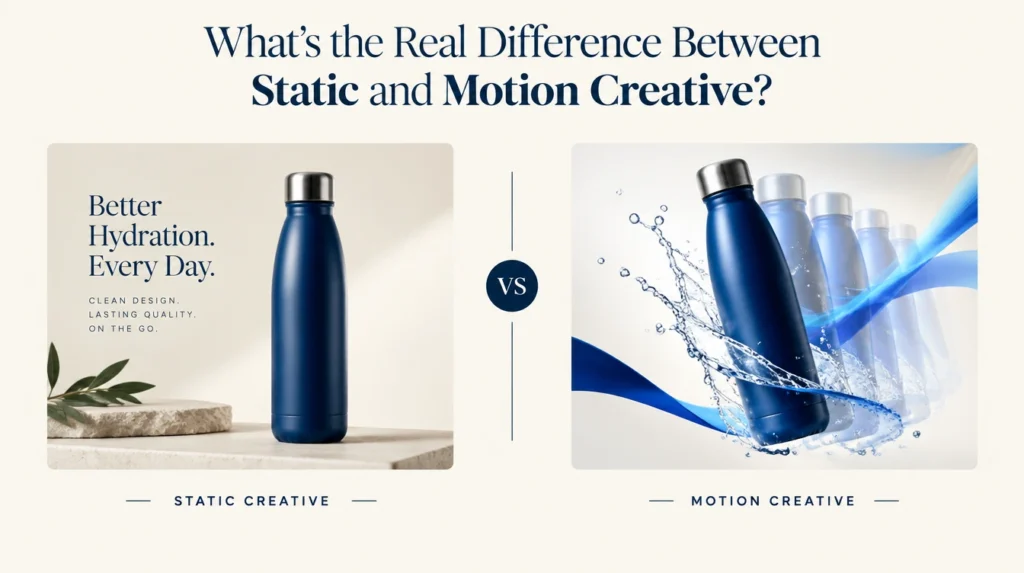
Static creative is a single frame: an image, a graphic, a product shot with copy. Motion creative moves: video, animation, GIFs, or cinemagraphs. The split matters because each pulls a different job. Motion grabs attention in a scrolling feed. Static delivers one clear message fast and cheap.
Two metrics decide most of this debate. CTR, or click-through rate, is the share of people who see the ad and click it. CPA, or cost per acquisition, is what you pay for each conversion. Motion tends to win the first. Static tends to win the second. Hold onto that, because it shapes every decision below.
Does motion creative actually outperform static?

On attention, yes. On efficiency, no. Video ads average a 1.84% CTR and 4.7% engagement rate. Static sits at 0.94% CTR and 1.2% engagement. But static flips the result where it counts for direct response: a 4.1% conversion rate against video’s 3.2%, and a $37.80 CPA against video’s $52.10.
So “which is better” is the wrong question. Better at what? According to ATTN Agency’s static vs video benchmarks, video earns the click and static earns the cheaper sale. Both numbers are real, and they point in opposite directions.
Here is the honest take. More motion is a cost, not a default. Video takes longer to make, costs more to produce, and burns through creative faster. That spend only pays off when attention is the actual bottleneck.
The real-world mix backs this up. In an analysis of 67,000 Meta ads, the median ad account ran 61% static and 39% video. The accounts winning on efficiency were not all-video. They leaned static and used motion where it earned its keep. At Morphiaas USA, a performance marketing agency serving businesses across the United States, we see the same split hold on most paid accounts.
When should you use static creative?

Use static when the message is simple and the goal is conversion. It wins at the bottom of the funnel, where the viewer already knows you and needs one clear reason to act. An offer, a price, a single benefit, a retargeting nudge. Static says it in a half-second, and it costs a fraction of a video to make. Our creative design services build both formats to match the job each one has to do.
Static also fits fast-moving feed placements where a strong headline beats movement. A sharp product shot with a bold price can out-convert a slick 15-second video, because the viewer gets the point before a video even loads. For a retargeting pool that already saw your brand, a clean static offer often carries the lowest CPA in the whole account.
When should you use motion creative?

Use motion when you need attention or a demonstration. It wins at the top of the funnel, where nobody knows you yet and the first job is to stop the scroll. Motion shows a product in use, tells a short story, and lifts ad recall in a way a still image cannot.
Placements matter here. On TikTok, video pulls a 2.3% CTR against static’s 0.6%, a gap far wider than on Meta. If Reels and TikTok are your growth channels, motion is not optional. We learned this the expensive way on a DTC account that ran static-only on TikTok for a month and got almost no traction, then tripled its reach the week we switched to native video. For more on the format itself, see our guide on what digital creative design is and why it matters.
Static vs motion creative, side by side
Each format has a clear lane. This table lines up where each one earns its place, so you can match the format to the job instead of guessing.
| Factor | Static creative | Motion creative |
|---|---|---|
| Best funnel stage | Bottom (convert) | Top (attract) |
| Strength | Efficient conversion, low CPA | Attention, CTR, ad recall |
| Weakness | Lower stopping power | Higher cost, higher CPA |
| Cost and speed | Fast, cheap to produce | Slower, more expensive |
| Best platforms | Meta feed, Display, retargeting | TikTok, Reels, Stories, YouTube |
So which should you actually run?

Run the one that fits the goal, then test the other against it. Start from what the campaign needs: cold reach wants motion, warm conversion wants static. Pick the format that matches, build a strong version of the opposite, and let real spend settle it. The format is a variable, not a belief.
We proved this on a Houston DTC fashion brand. The account moved monthly revenue from $2,079 to $21,703 and lifted conversion rate from 0.30% to 1.37%, and the winning mix was not all-video or all-static. It was motion up top to win cold attention and static down low to close cheap. Source: Morphiaas USA client campaign data, 2024.
The deeper question, how you measure which creative truly drives revenue, belongs to testing and attribution. That is where our performance media program lives, built to read ROAS and CPA cleanly so the format debate gets settled by numbers, not opinion.
Not sure which creative mix your budget should run? We benchmark it against your numbers and tell you straight.
Book a growth auditFrequently asked questions
Which converts better, static or video ads?
Static usually converts more efficiently. Benchmarks show static at a 4.1% conversion rate and a $37.80 CPA, versus video at 3.2% and $52.10. Video wins the click and the attention, but static tends to close conversions at a lower cost, especially for warm, bottom-funnel audiences.
Is motion creative always worth the extra cost?
No. Motion costs more to produce and carries a higher CPA, so it only pays off when attention is the bottleneck. For cold, top-funnel reach on TikTok or Reels, it is usually worth it. For warm retargeting, a cheap static offer often beats it on cost per sale.
Do static ads still work in 2026?
Yes, and the data is clear. In an analysis of 67,000 Meta ads, the median account still ran 61% static. Static remains the efficiency workhorse of most paid accounts, particularly for conversion and retargeting, where a clear single message outperforms movement.
What static-to-video ratio should I run?
It depends on spend and channel, but most accounts land between 60% static and 50/50. Smaller budgets lean more static for efficiency; larger budgets and video-first platforms push more motion. Treat the ratio as a starting point, then adjust based on what your own data shows.
Which format is better for a small budget?
Static, in most cases. It is faster and cheaper to make, and it carries a lower CPA, so a limited budget stretches further. Add one or two motion pieces for cold reach once the static workhorses are converting, rather than starting with expensive video.
Your creative choice should show up in the numbers, not just the feed. We build the mix and tie it to your growth.
Get a benchmarked growth audit